(incoherent joy)
February 22, 2023
cue astonished screeching: I’VE BEEN SHORTLISTED FOR THE ARCTIC CIRCLE RESIDENCY!!!!!

cue astonished screeching: I’VE BEEN SHORTLISTED FOR THE ARCTIC CIRCLE RESIDENCY!!!!!
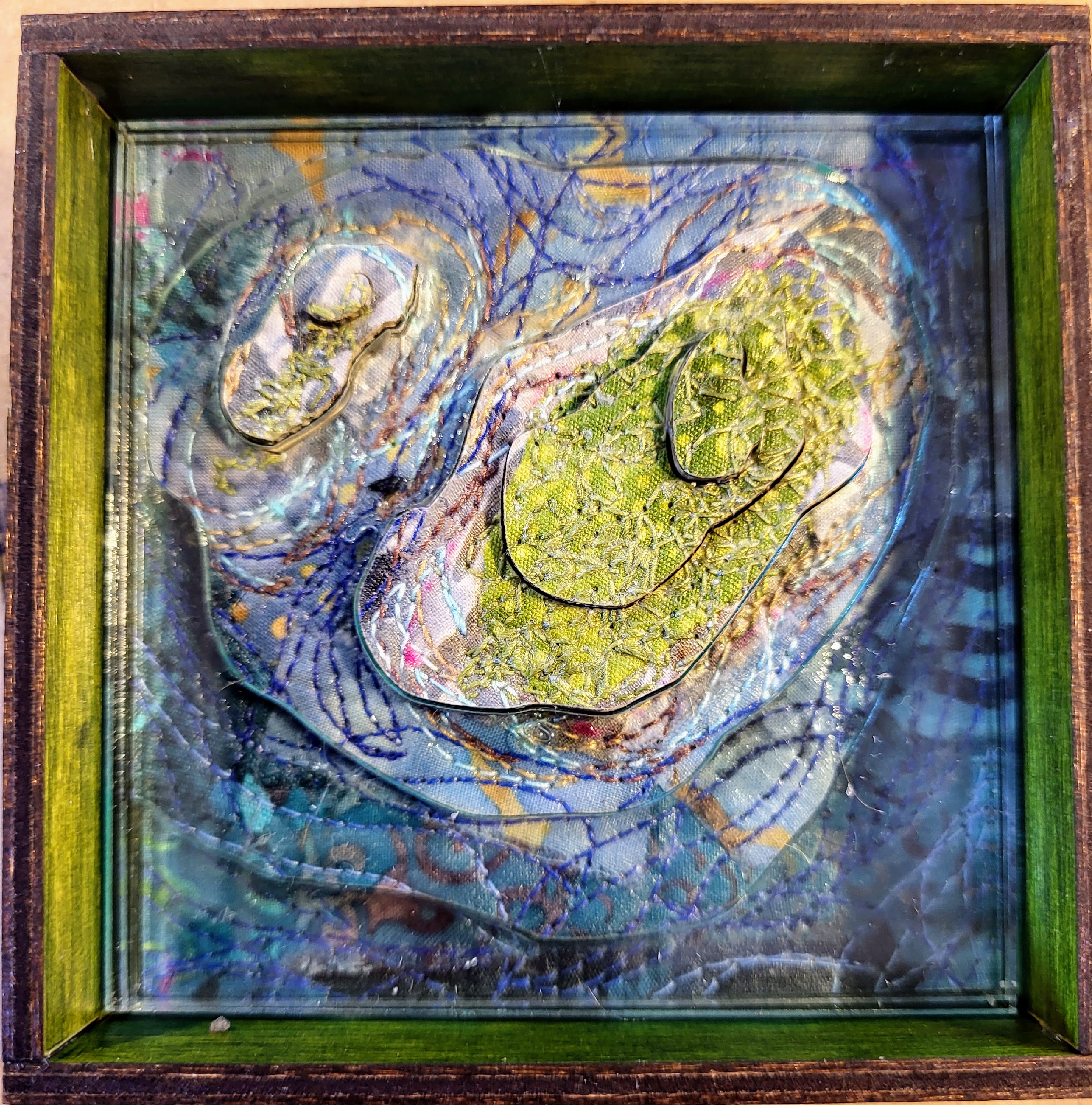

Some of the new little boxed landscapes and seascapes I am working on. I have a trunk show coming up at Sawmill River Arts Gallery on February 25th, so I’m working on these little guys right now. These rivers have fall colors going on, with more showing winter, spring and summer colors. They are 2×4 inches (50x100mm). The islands and coastlines are mostly summery, they are 3 inches (75mm) square, all cozy in their little boxes.
The coastlines are all pieces of Maine, simplified. The rivers are short sections of the northern Connecticut River, even as they are also things that all rivers do in areas with little slope. I am ridiculously fond of them!
More new pieces – these are Monhegan Island, off the coast of Maine. There are a small number of year-rounders, making the island community work through the wild winter weather. In summer, the island teems with visitors: tourists flock to see the scenery, artists come to paint, and birders come to see migratory birds on their way further north. We’ve been out almost every summer for a week or so, to catch up with family and friends. It is not a very big island, but it is dense with scenery.
Photography by Stephen Petegorsky, again!

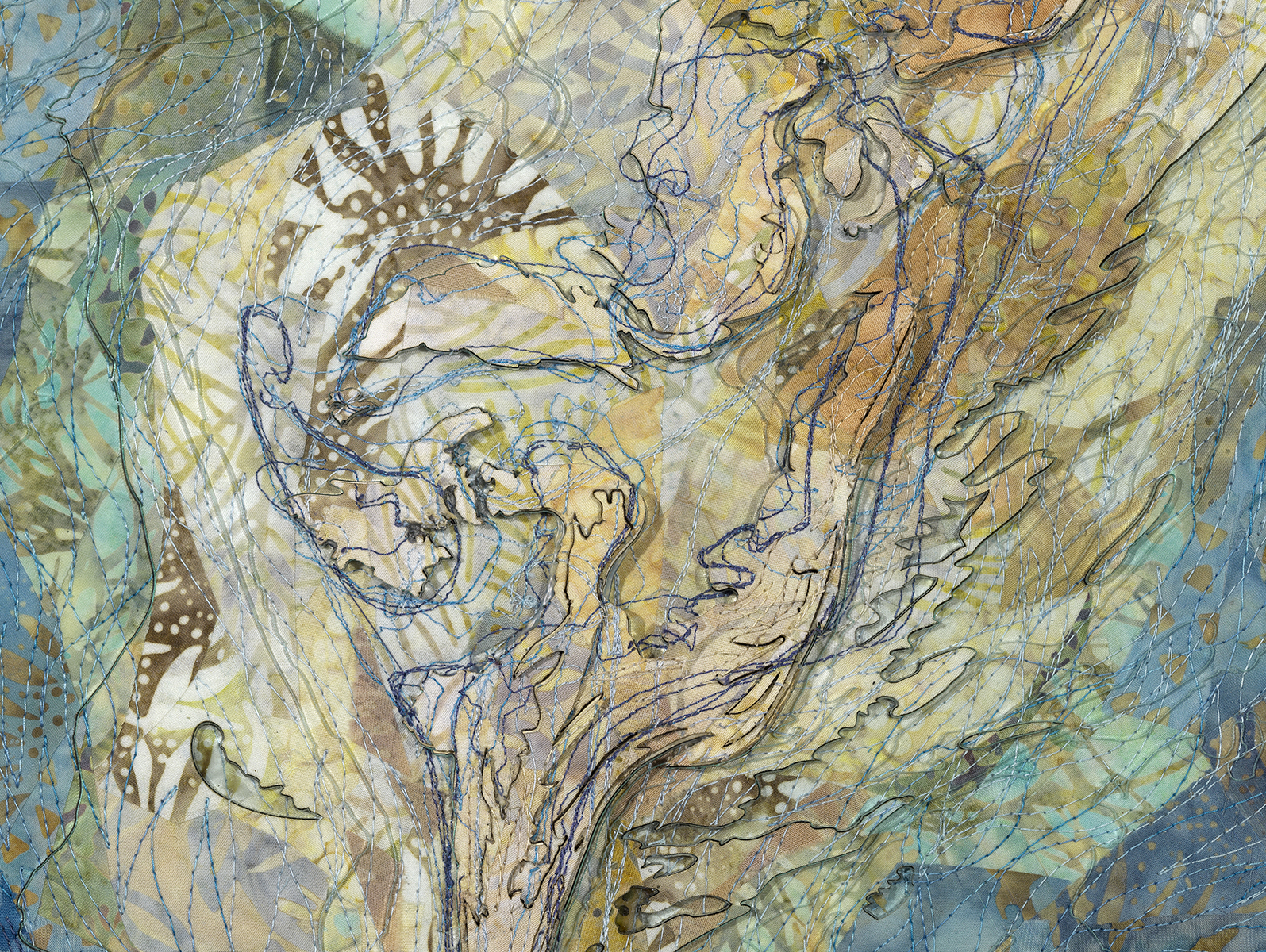


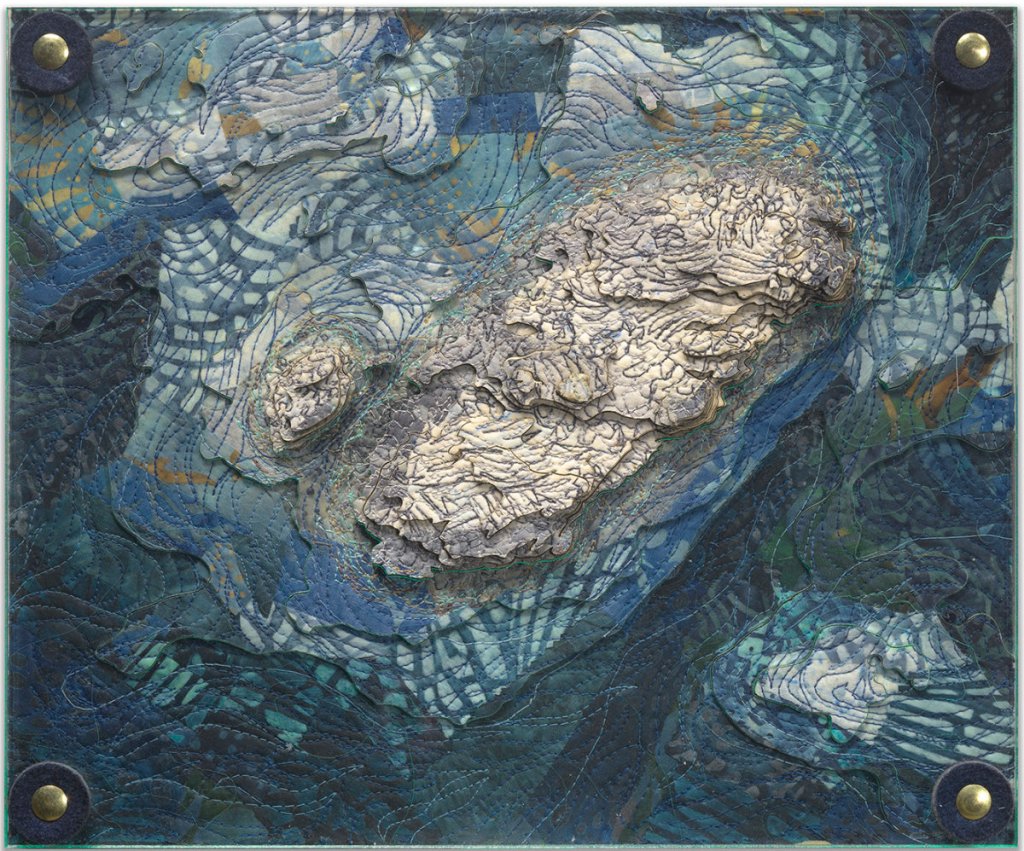
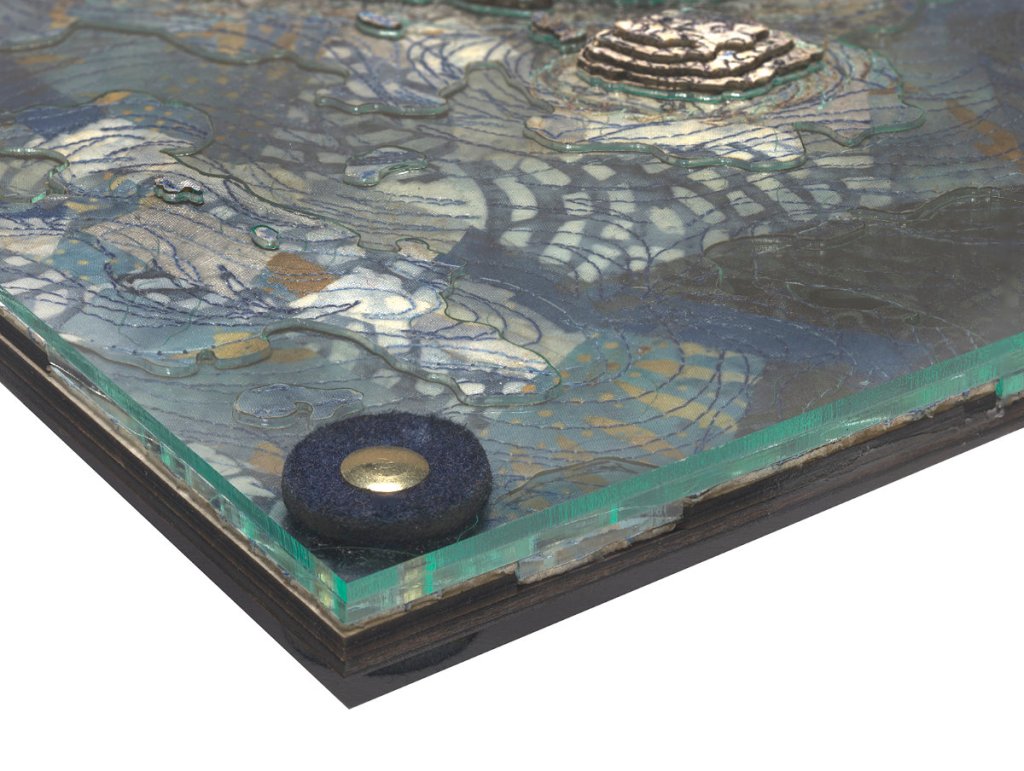
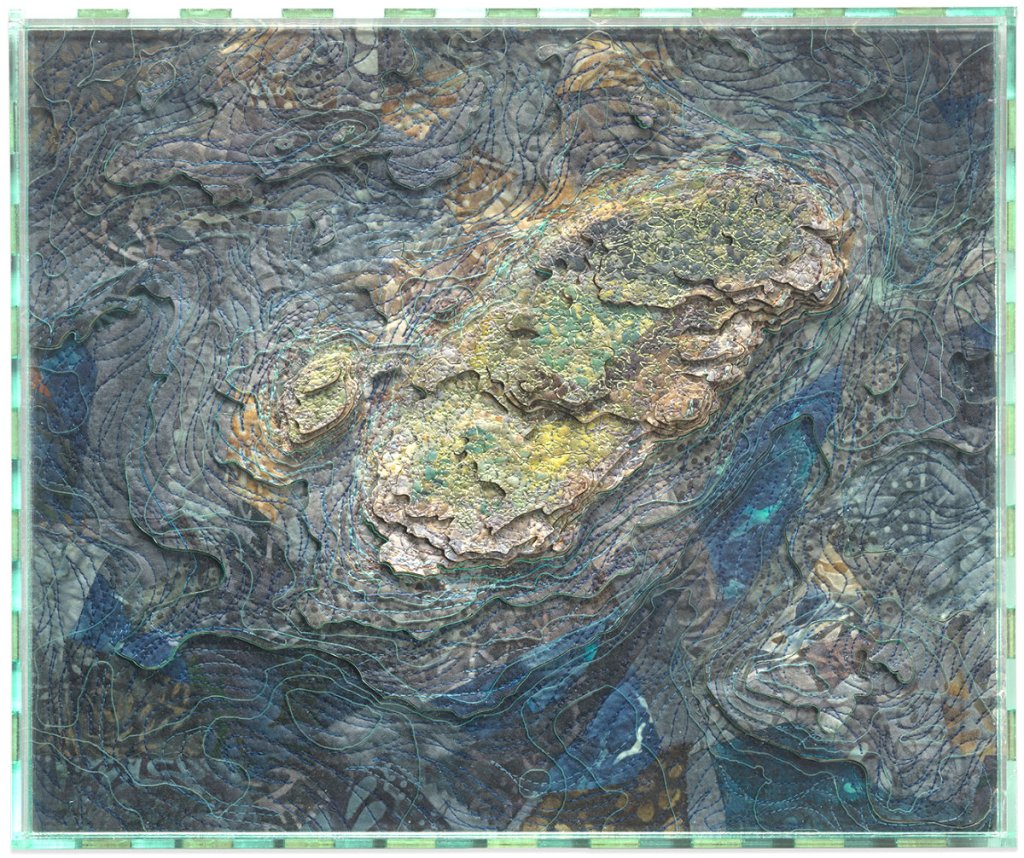
Stephen Petegorsky does amazing and beautiful work – here are the official pictures for the most recent pieces, Monomoy Island and Crane’s Beach.
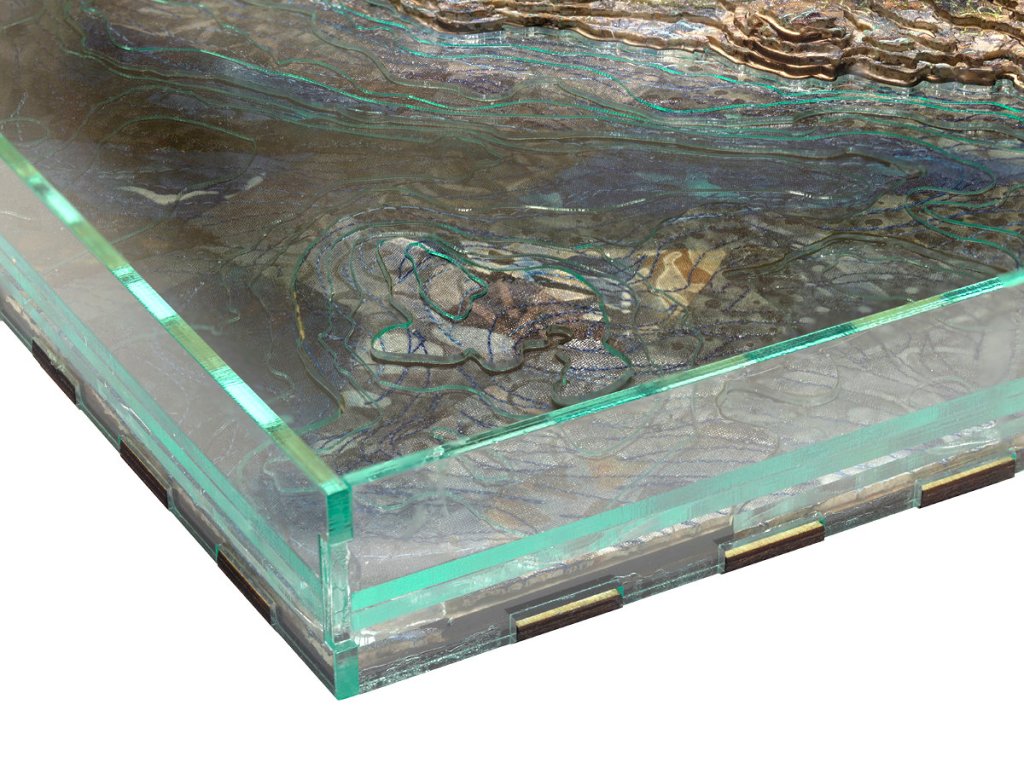
I have been struggling to photograph my most recent work. It has layers of plexiglass, and everything reflects (when it doesn’t have fingerprints, dust or bits of thread on it) and capturing the depths of the work is hard.
This one is Monomoy Island, south of Chatham, on Cape Cod, Massachusetts. In 1979 a winter storm broke through the center of it, and I was so stunned by the idea of change in the environment I’ve paid attention to what the coastline there looked like ever since. Landsat imagery has given us a historical record for the last nearly-fifty years, so I pulled twelve images that showed the most dramatic shifts of the coastline, and used those to draw in the coastlines. The lines are stitched onto a fabric collage where fabric color indicates ocean depth. Then the fabric is sliced along contour lines, and draped over a cardboard elevation model, with plexiglass layers representing ocean at each depth. The top plexiglass layer is sea level, even with the modern coastline.

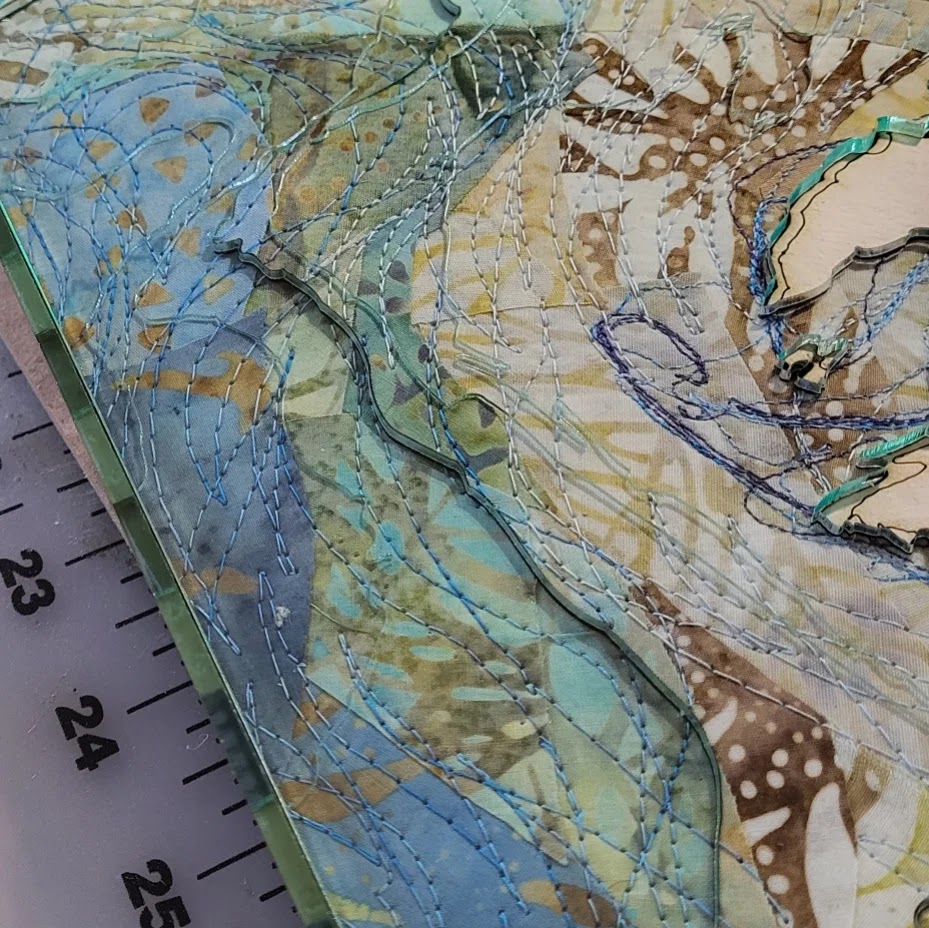

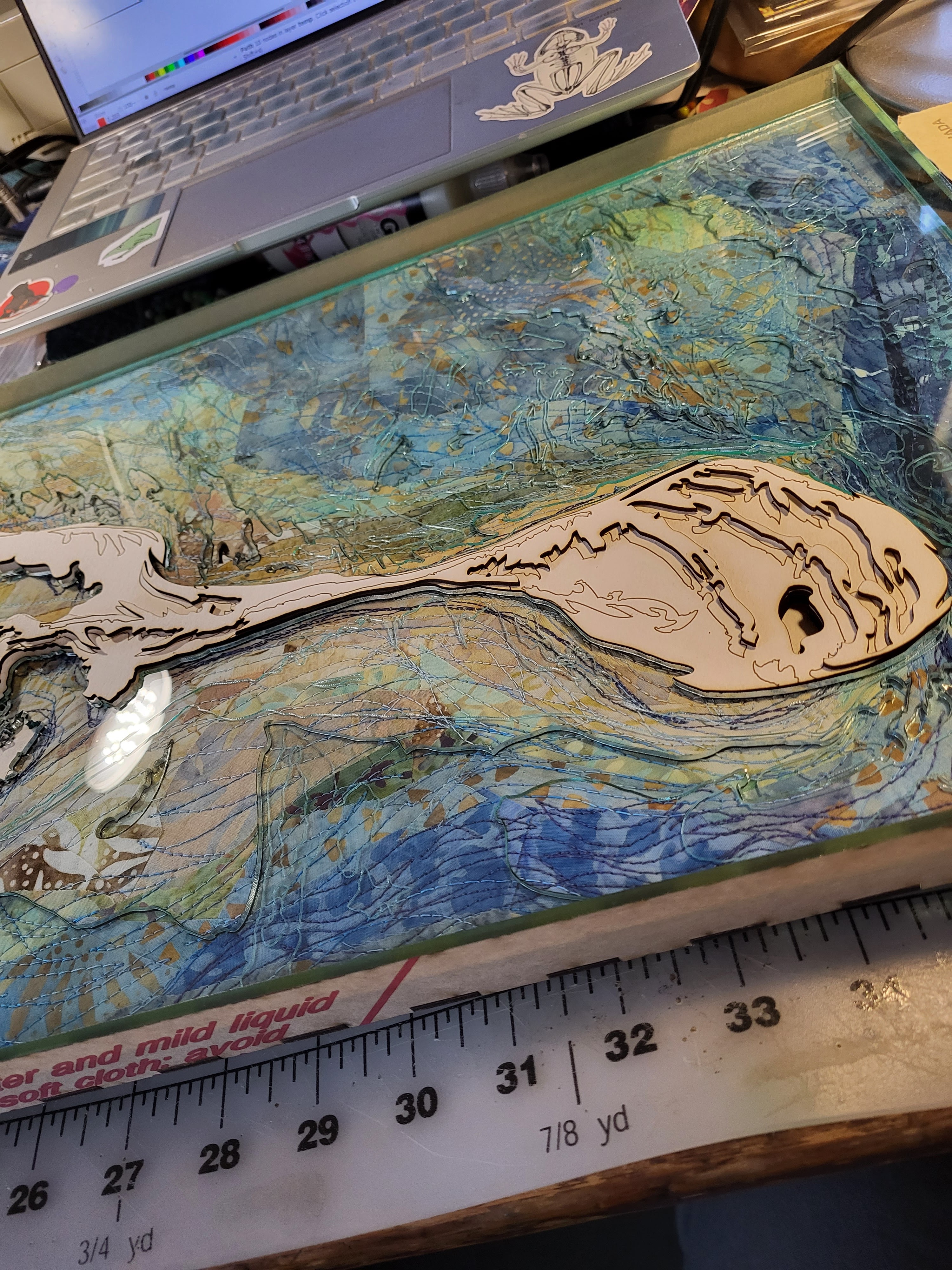
This piece is Cranes Beach in Ipswich, Massachusetts, on the coast north of Boston. This highlights the marsh and island ecosystem that exists behind the barrier beach.
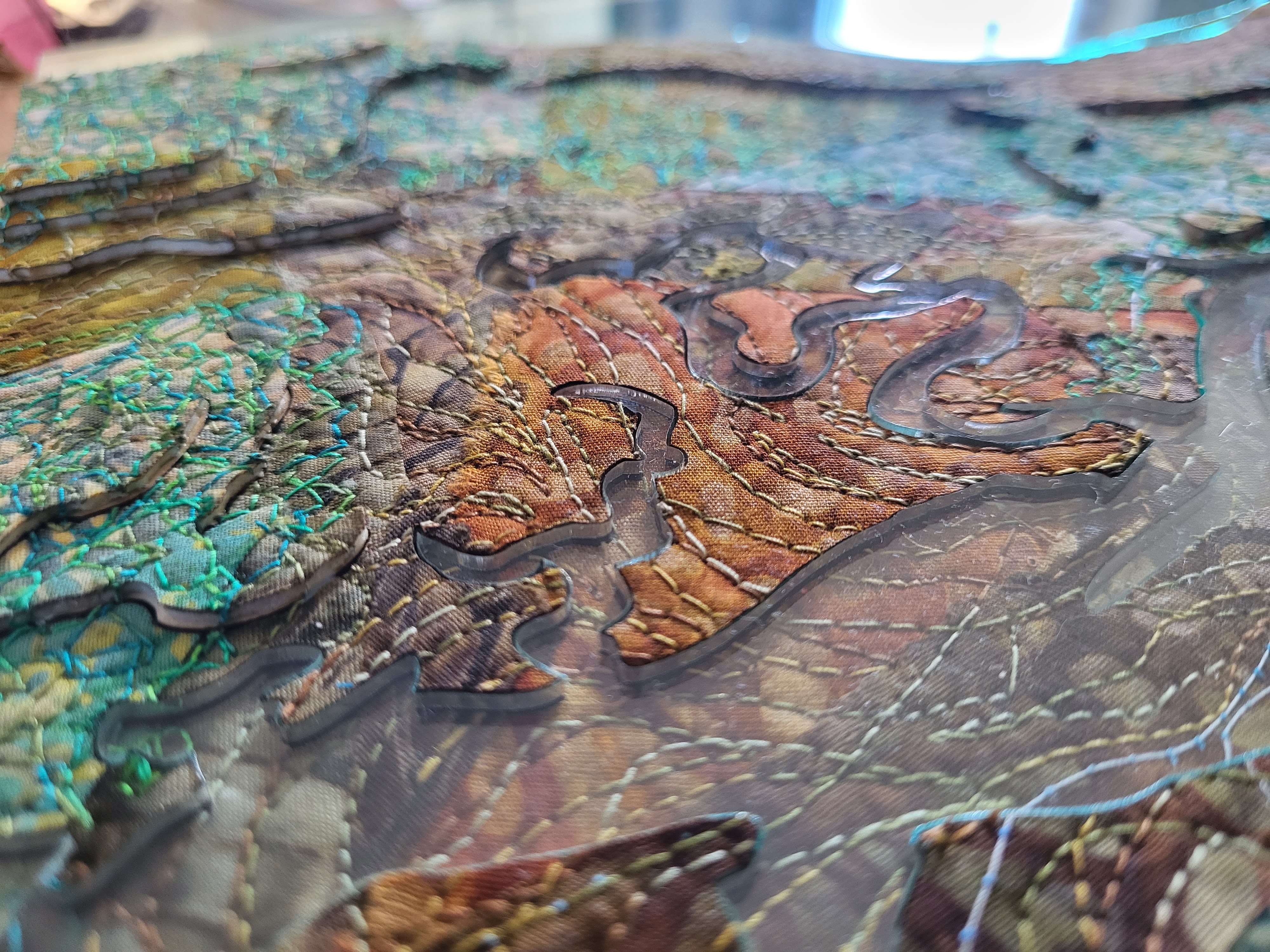

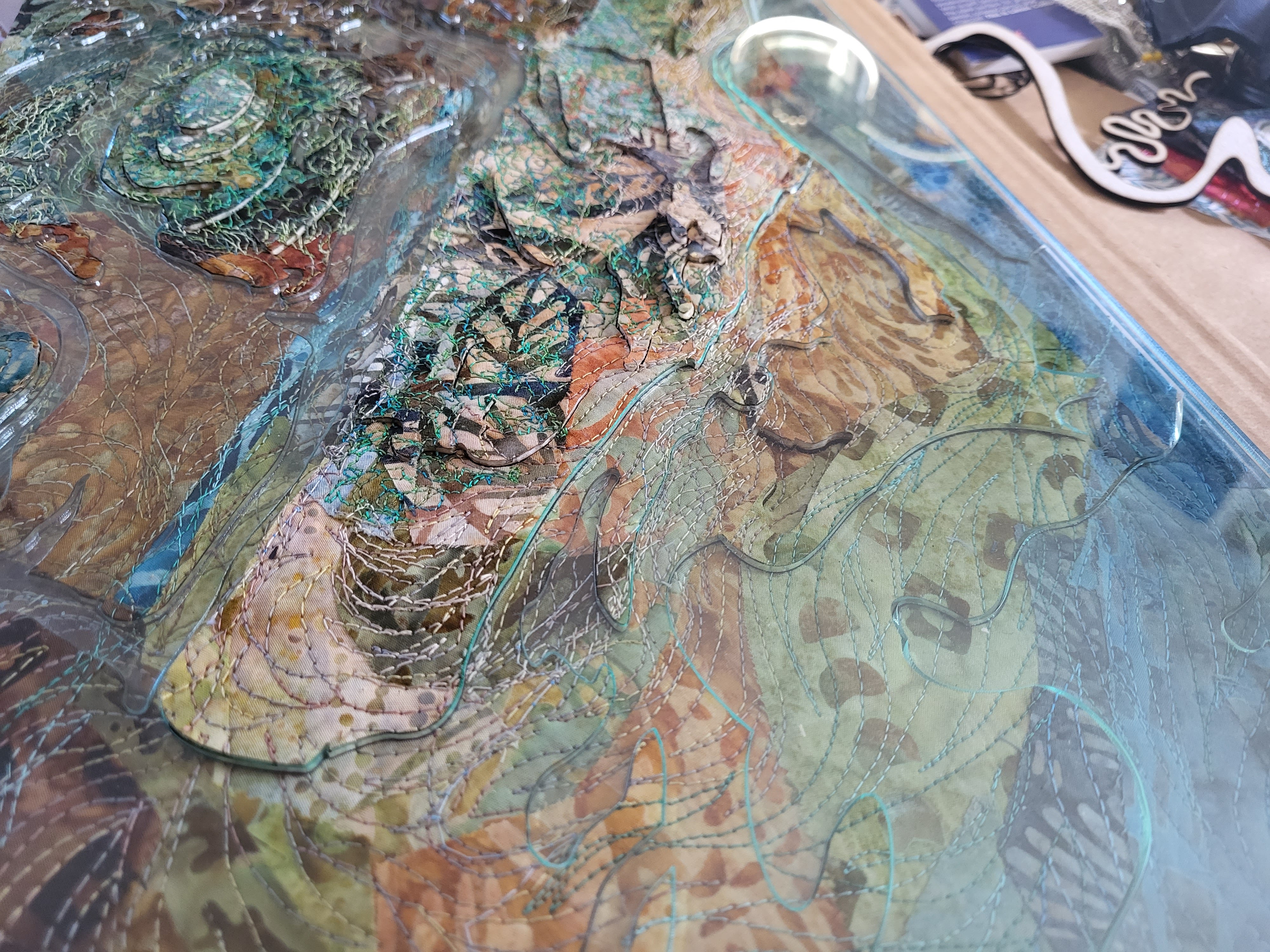


These are going to a professional photographer who will have the right tools and knowledge to get pictures. Thank you Steven Petegorsky for having the the chops to accomplish this.
I’ve been evolving ideas about form? I have in my head a vision; of a coastline, and the way the topography holds water and the tide goes in and out across it, and of rivers and the way they migrate across their floodplains – I want to show that. I’ve made a series of layered works, experimenting with cutting and layering stitched fabric over and under layers of plexiglass representing water.
Rivers look like this:


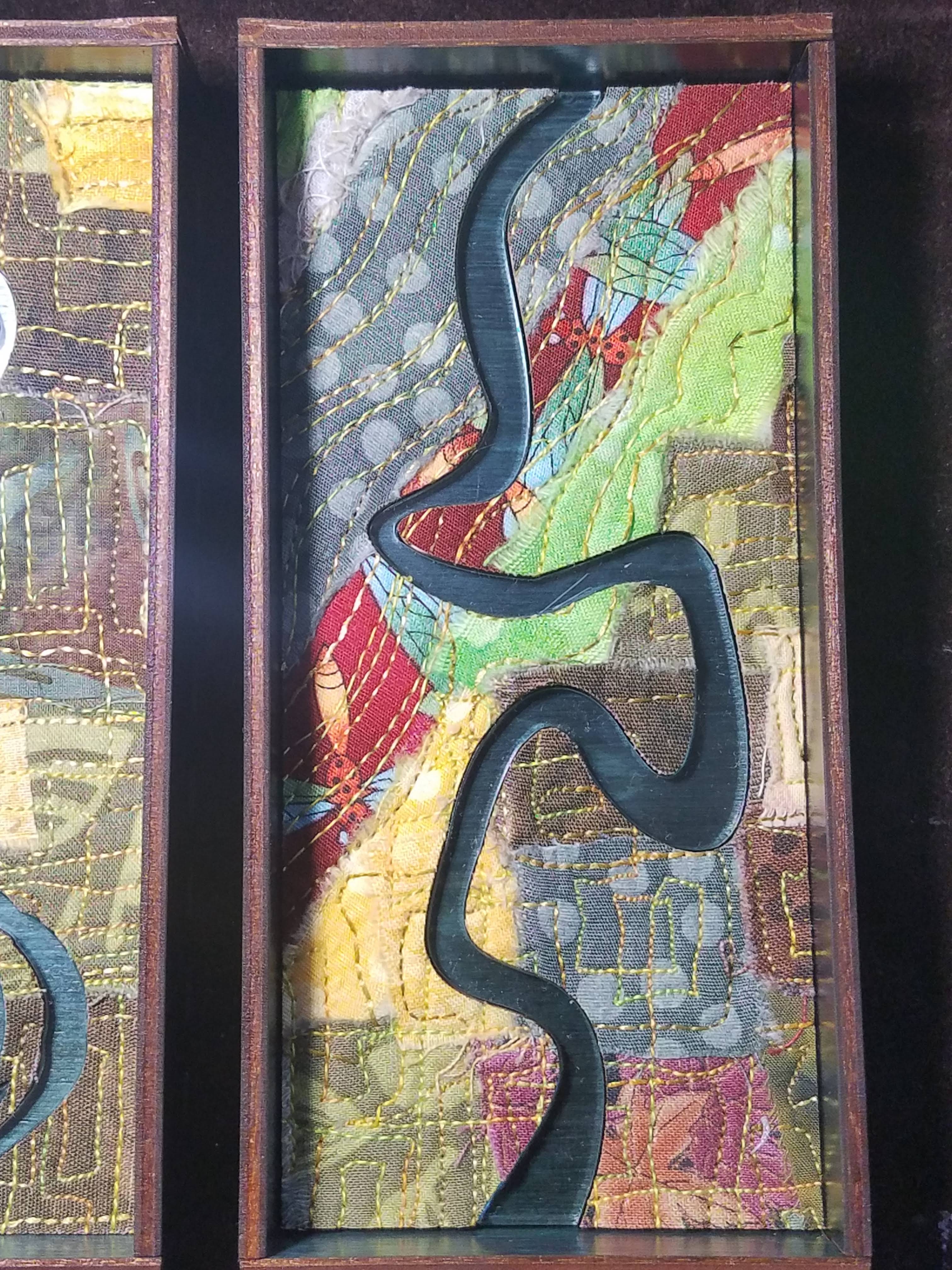
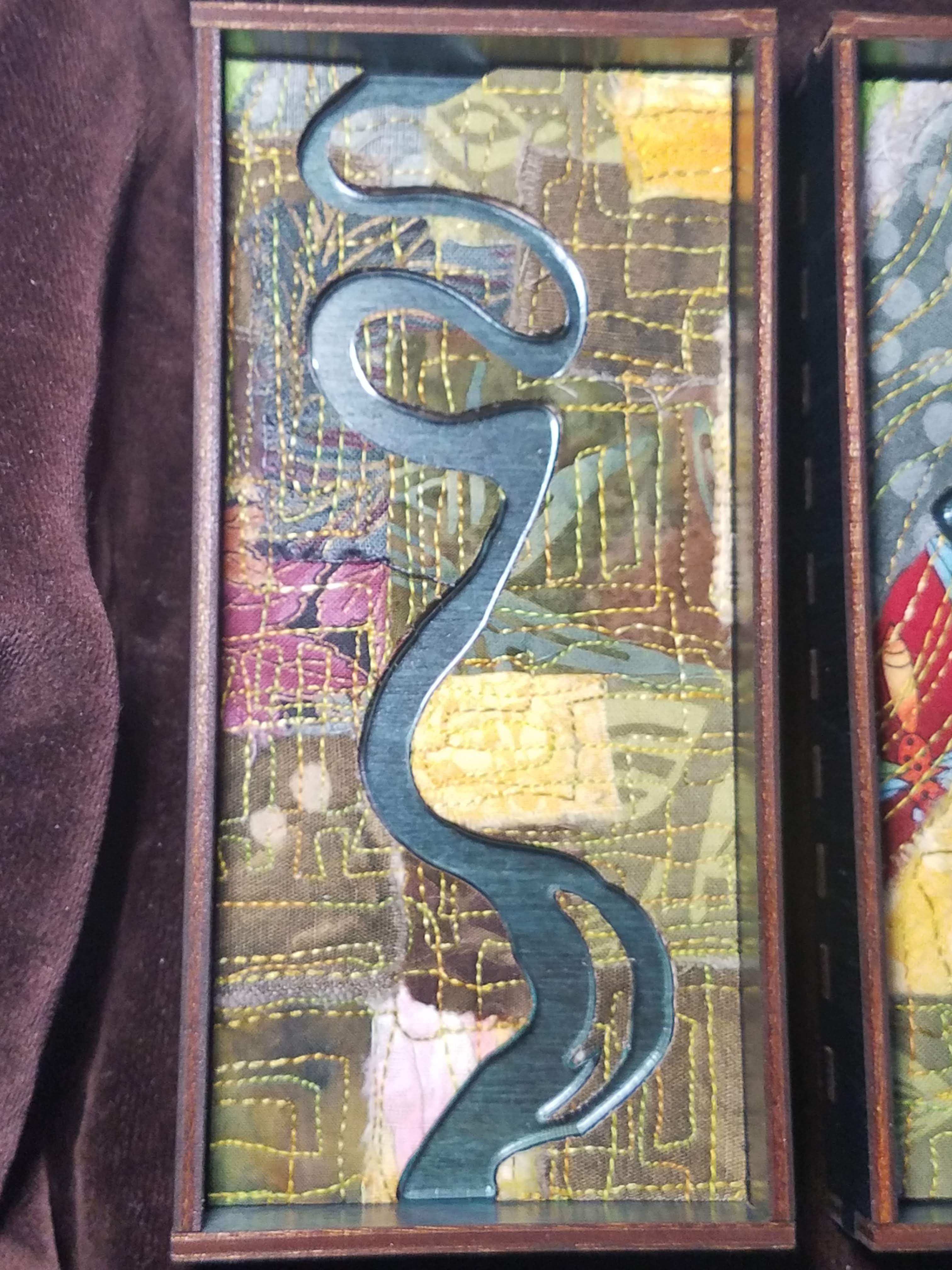
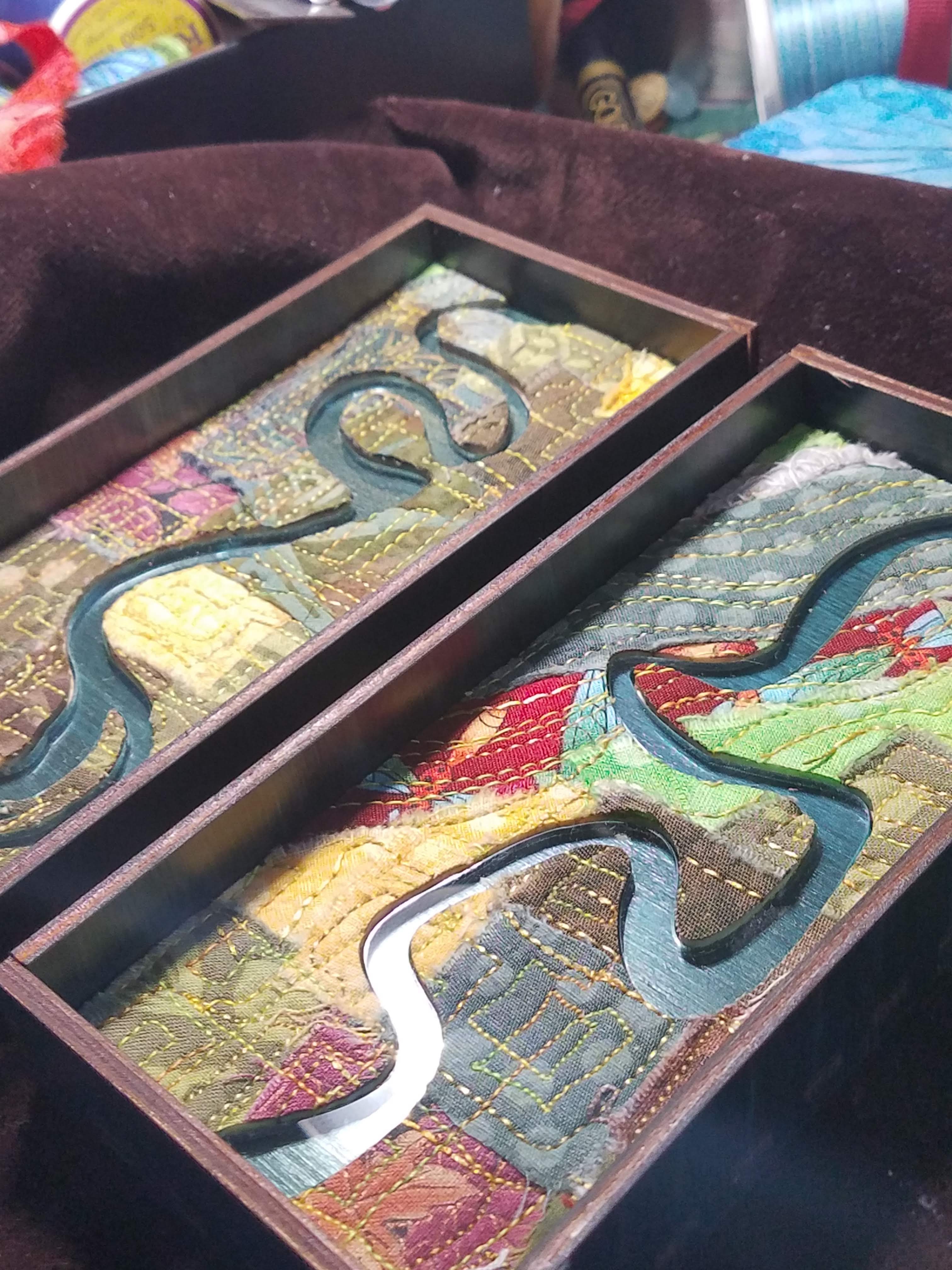
All the layers get cut on the laser cutter, so that the shapes all fit together perfectly. There is the layer of stitched fabric on thick interfacing, a layer of taskboard to raise the fabric higher than the plexiglass, and the layer of plexiglass. I can rest the plexiglass on box, or I can put the cutout river section of the stitching under the plexiglass, so the continuity of the landscape is clear.
Coastlines are a trickier undertaking:


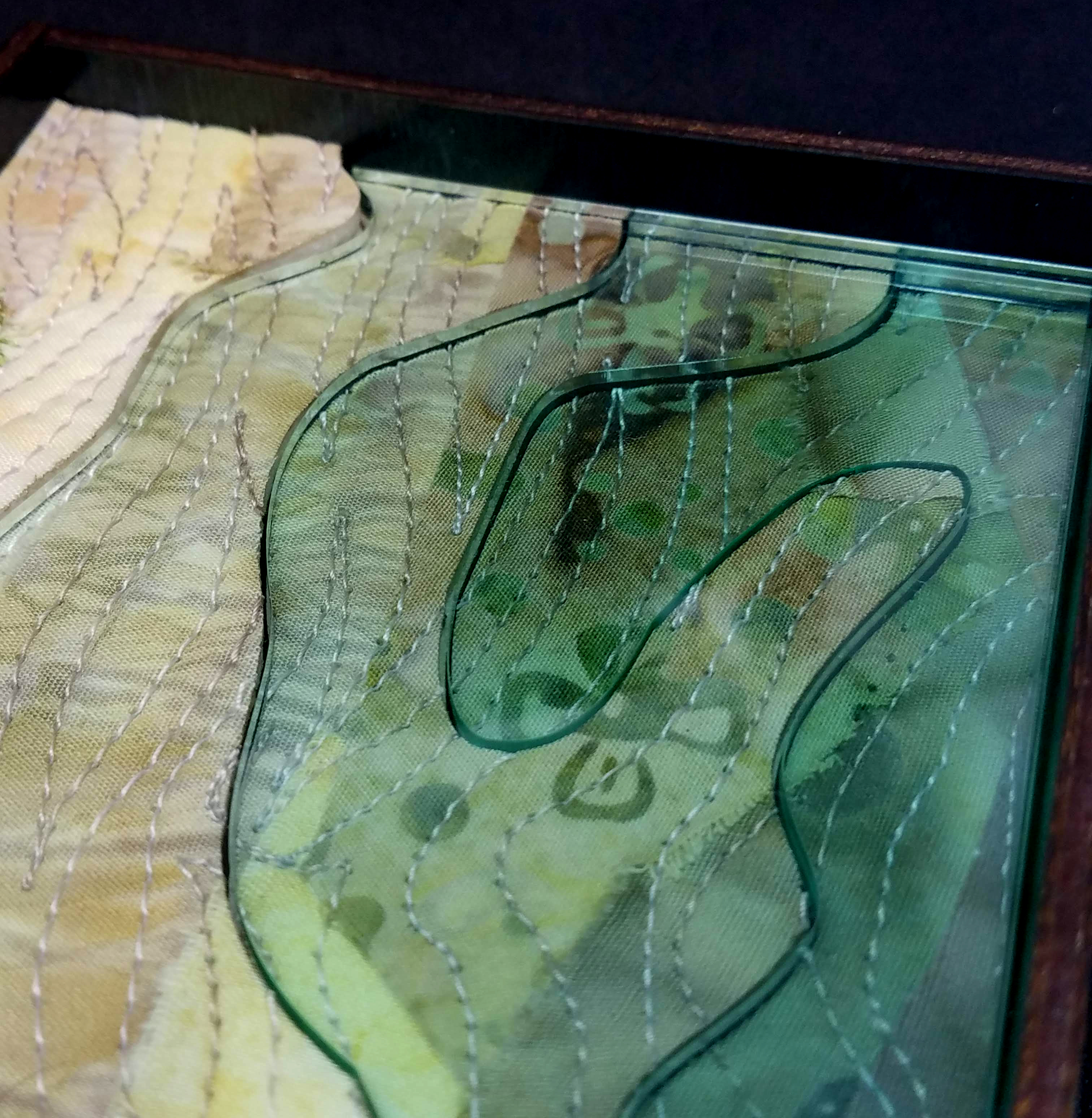

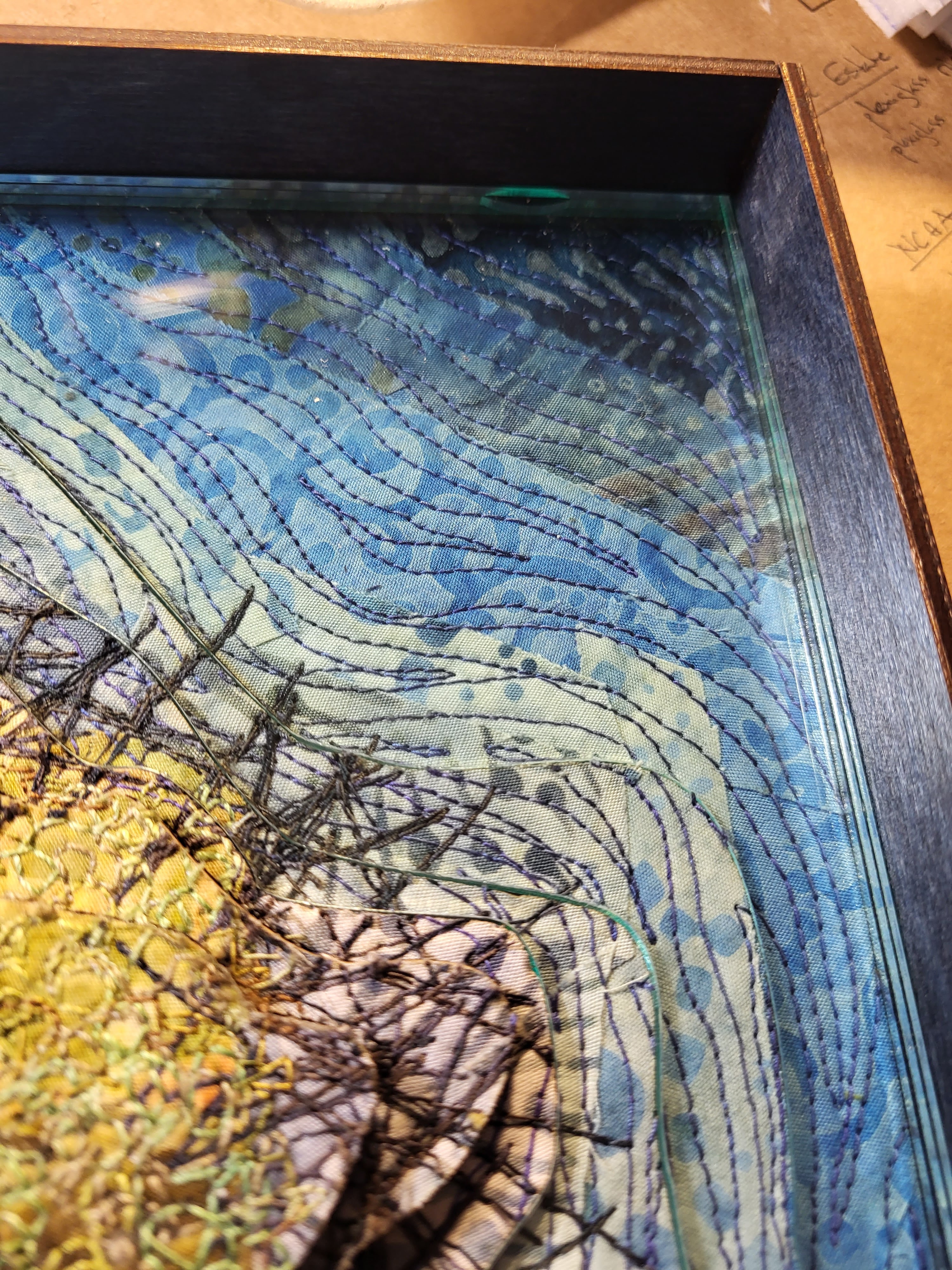
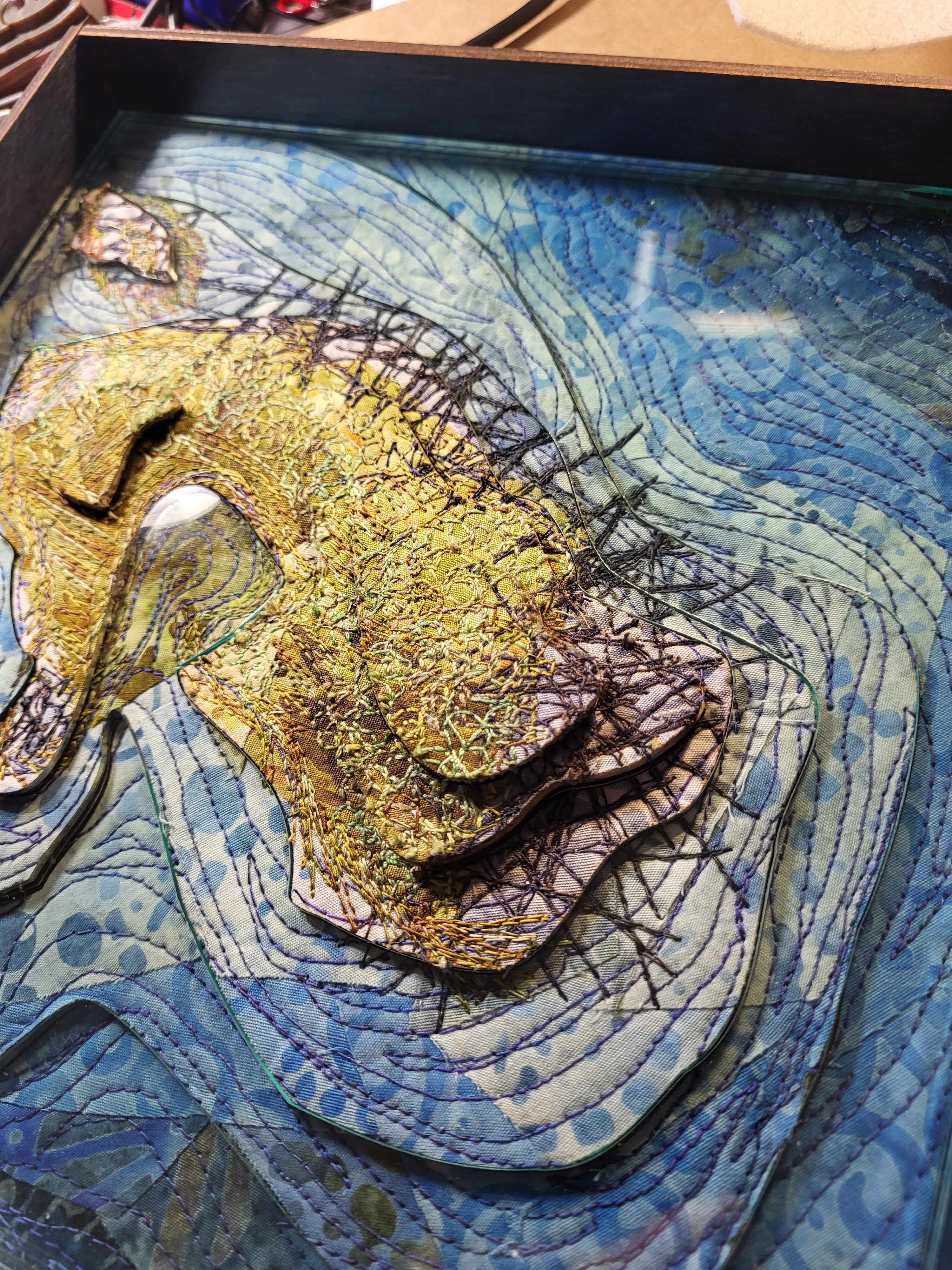
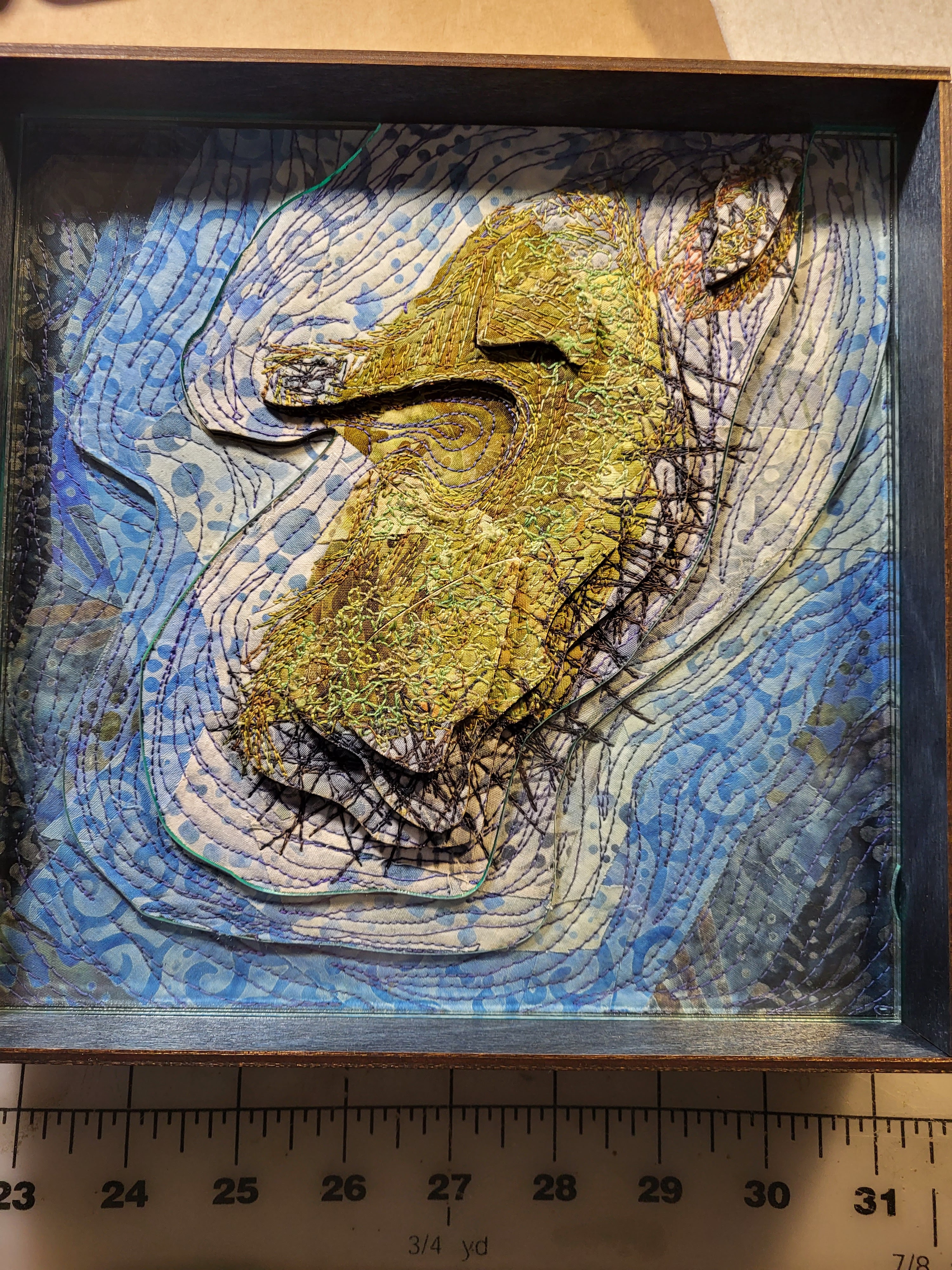

Coastlines go down into the water, and rise up out of the water, so there are more layers of taskboard that need to overlap in the right places and the fabric and stitching have to be in the right places, and the layers of plexiglass have to fit the cutout shapes of the taskboard… it feels like a lot of parts to keep track of. And these are fairly simple examples.
I am working up to larger pieces with more layers, and working with real geography too.


Anyone walking over the bike path bridge this afternoon found a pair of humans with a lot of neon green parachute cord and a neon pink water proof case with a phone in it, giggling madly. My friend Matt (new to blogging, doing some interesting things with card stock construction) and I tied my phone in a pink water proof case and tossed it dropped it carefully off the bridge as close to the river as we could. We got it down near the ice, and near some open water off a different section of the bridge, and even right into the water in one place (it was dark. And not at all clear what we were looking at).
We made a couple videos too, but they have a lot of extraneous motion and are hard to parse. Also they take for.ev.er to upload.
Seeing the underside of the bridge, seeing the river up close, seeing the ice, and the surface – all those made me think about the river a little differently. Which means I can make some new art based on a different point of view.

days have rhythms
of rise and (shine or not)
of sun and light and lunch
and the slow tumble of the afternoon to evening
slouching more deeply into the couch, then
staggering upstairs to bed

Weeks have a rhythm imposed by expectation? Experience?
on Sunday we do nothing, as aggressively as possible
and then the work week drags its way across our desks
with increasing delight (or relief) to Friday
when we wonder where the week went? again?

months do not have rhythms, except to think
Oh, February already? and then
what? July? in the next breath
but I can find no internal rhythm to a September,
or March, or any other month -
although sometimes a great yellow moon
comes shouting through the window
into the living room in the dusk

years have a rhythm
of daylight and darkness,
of warmth and cold
of green and gold and purple gray and back
around to the clear green haze of spring
and mud underfoot, and new things starting
burgeoning, pressing forth

The rest are all imposed? invented? by humans,
the decades and centuries
the generations,
eras and epochs

still earth keeps track
day by day
year on year
a vast clock, spinning
through time and space
Which is to say, I have been doing things, useful things even, and simply not writing about it.
Happy solstice – the days are getting longer in the Northern Hemisphere. Thank you for keeping the sunlight for us, in the Southern Hemisphere.

Things I have done since January 23, 2021
It’s been a while – what have you been up to?
Hey Friends! We are half way thought January 2021 (I know, it feels like another damn decade, but no, it is just that full of incident) and it is time to think about, and make your plans for, doing something daily in Feb 2021. I have posted these “rules” before, for Feb 2020, and Feb 2019. I’ve been recruiting friends for almost as long; from Clevermanka.net, and Jenny Crusie’s Argh people, as well as anyone else who is inspired by seeing it here or on Instagram.
Below are some images from #dailyFeb2018, #dailyFeb2019 and #dailyFeb2020:


February, as we all well know, is the longest month. The Romans did us a favor by chopping days off it until it felt as long as July, but since it has only 28 days this year, it is technically shorter by two or three days than any other month we have.
Since we are going to do something daily, picking Feb to start seems like a good plan. And yes, we are going for daily, which is why we have The Rules, outlined and explained below.
In order to keep from being overwhelmed, we have Rules, and the Rules are what we must have:
Let me explain.
A Very Low Bar: The purpose of an absurdly low bar is to invite anyone and everyone to step over it, to prove, in fact, that anyone and everyone can step over it. Having stepped over it gives you a little jolt of accomplishment, which is a good thing, and encourages you to do it again. We are after that tiny jolt of encouragement that comes from doing the thing. That will propel you to do it again, and again, and again, which is practice. So choose something you have tools for. Choose something that you can set up quickly and clean up easily (or set up in a corner somewhere that won’t be disturbed). Lower the threshold for doing the thing as much as you possibly can. To that end, it is perfectly legit to lay in a stock of things before Feb 1 – like pre-cut paper, sharpened pencils, the paints for this February’s palette, or all the ends of sock yarn you have on hand. Get a little excited about this process!
Very Clear Boundaries: This is a lesson from Twyla Tharpe’s book The Creative Habit , reinforced by personal experience, and even Orson Welles (“The enemy of art is the absence of limitations.” ) To this end, 1) you must put some lines around what you want to practice, and B) make that measurable. So choose a size, limit your palette, limit number of stitches you are knitting, limit yarn size, commit to buying nothing new, or using up all of a resource, do whatever you need to make the box you are creating around your project small enough to be a little constrictive, so that you can experiment with pushing at the edges without having to spend too much time finding the edges first.
Quantity Not Quality: To make that measurable, choose metrics you can see, and count, things that are strictly mathematical or true/false. Your metrics matter, a lot. “Make one nice picture” is useless because who says it is nice? “Use up all the paint I have” is a very good metric because you can tell when you’ve achieved it and also it is pushing you towards more using and making.
I will posting my work on my Instagram account, using the #dailyFeb2021 tag. Post your work too! Use the tag to boast about your own work, and see what other people are doing. Everyone’s friendly!