dreamboxes! Still for sale…

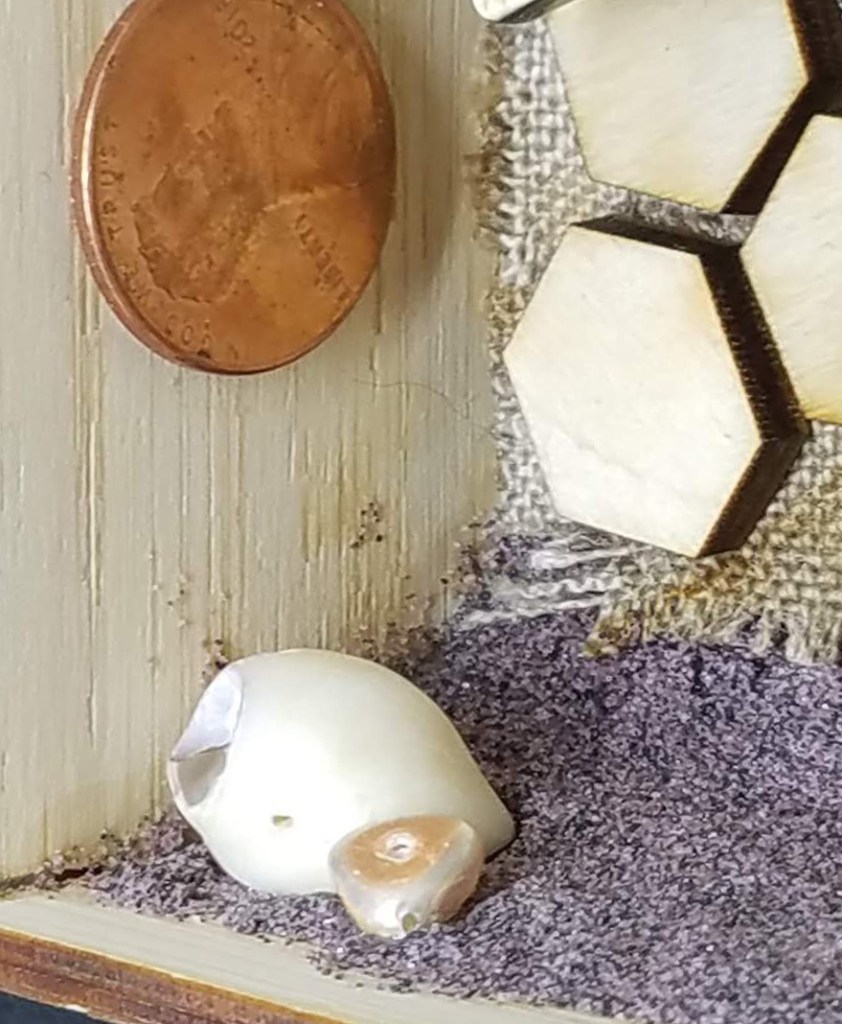
I still have a few dreamboxes for sale. These are the things I make that are hardest to describe. They are perfect wooden boxes, filled with tiny evocative things that I have found, saved, collected or been given. Things that are interesting enough by themselves, but gain mystery? emphasis? when placed together into a small box. My friend Troy described them as dreamboxes and it has stuck.

If you don’t see one that speaks to you, I have made several with specific themes on request, mostly bees, but one with ravens But there are already two with small white bears – one with the north star, and one with an extra bear – you must know someone who needs one?

bench notes; how to make line work cut-able

One reason I wanted access to a lasercutter was to cut things that are fiddly and annoying to cut by hand, and even to cut multiples of them. Things like finely cut tree silhouettes, window muntins, and frames for things are easy to cut from a variety of materials, once you have the line work ready to cut. These things are easy enough to draw as simple line work, but is a process to turn the lines into a thing.

  • draw the thing in Inkscape, (a vector graphics program) in this case a tree, using lines of various weights
  • transform the stroke to path, giving you an outline of all the different lines you drew
  • from here, I create a single outline from all that mess, using a command called Union
  • The end result is an outline that goes around the outside of all the grouped line work. This can be used as a cutting line with the laser, or further manipulated (reversed, shrunk, enlarged, etc).

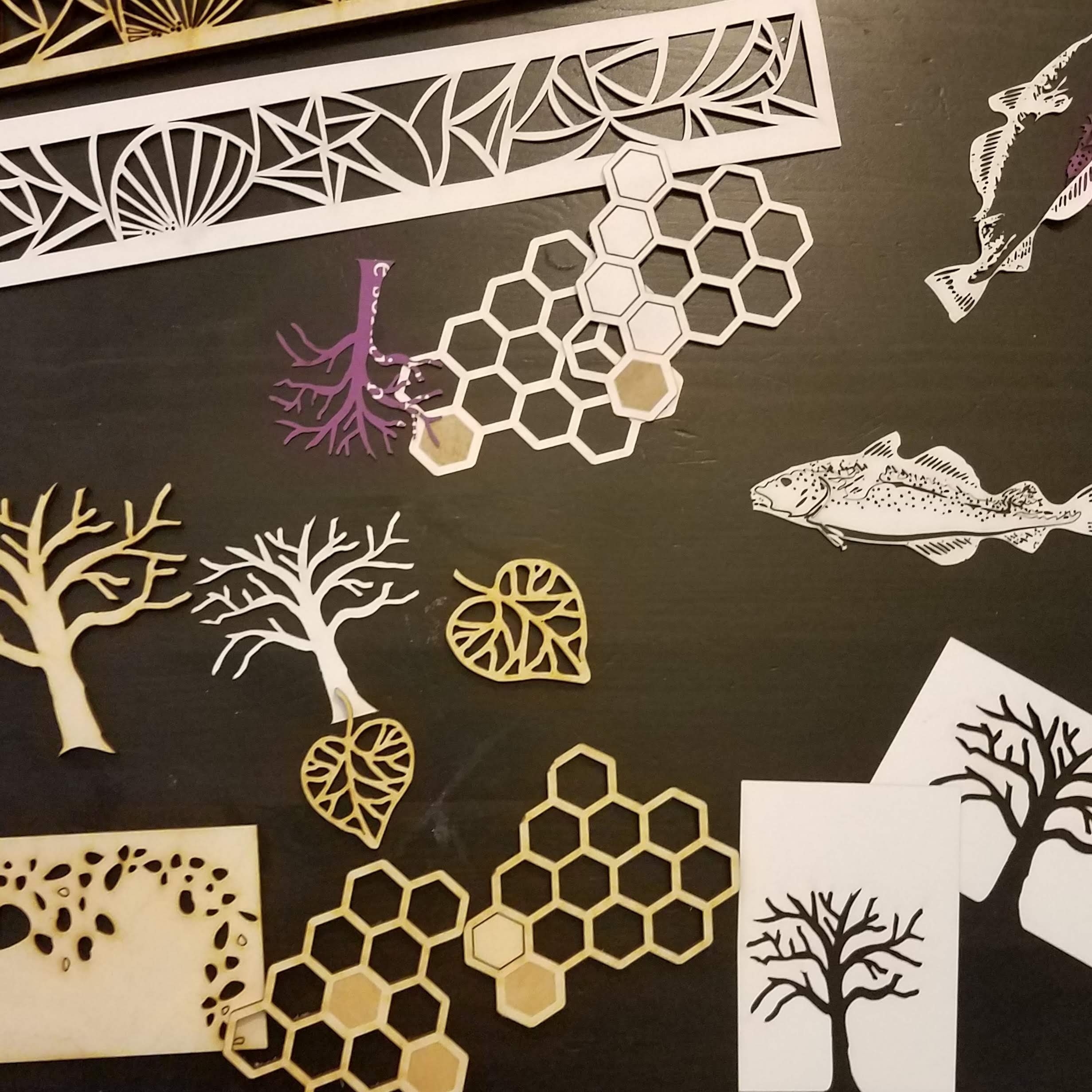
It works the same way for simpler shapes as well – below you can see a tree, a circle turned into small embroidery hoop, and a set of hexagons grouped into a honeycomb shape, already cut out.

fog

I use frequently use silk to represent water in my work. China silk makes a good sky, and dupioni and noil have a rougher texture that works well for ponds and streams. One of my favorites is silk organza; a stiff, translucent fabric that is easier to work with than other sheer fabrics. Organza is best to add depth and distance, as well as adding clouds, mist and fog.

The above pair of pictures are my attempt to make sense of layers of morning mist my friend Jen captured on her morning walk to her lake. I worked from the background of the picture forward, putting down each layer and stitching in details. On one piece, I left the organza loose, on the other piece I stuck it down with Misty Fuse, a very light fusible web that shows much less behind very sheer fabrics. The two pieces feel very different to me, and I’m not sure I like either of them.

One of my studio rules is: If you love something, do it again; also if you hate something, do it again. I didn’t love either one of these, but I do very much like particular details in each one. I think I have to make a third iteration, using both techniques, and see if I can catch the feeling I am aiming for. My thanks to Timna Tarr for her excellent performance as a rubber duckie* on Saturday.

*I am told, by people who program, that many engineers keep a rubber duckie to explain things to. Apparently describing the problem out loud, to a sympathetic audience, helps locate the problem. This works with someone who understands the problem, someone who does not at all understand the problem, or even an inanimate creature such as a rubber duckie.

In which I look back on a decade

20190928_161230
a lot of cake

I thought I wanted to celebrate turning 59, and look back on a decade of accomplishments. I invited friends to come via Facebook and email and face to face encounters. If anyone asked me if they could bring something, I told them cake, or something to drink.

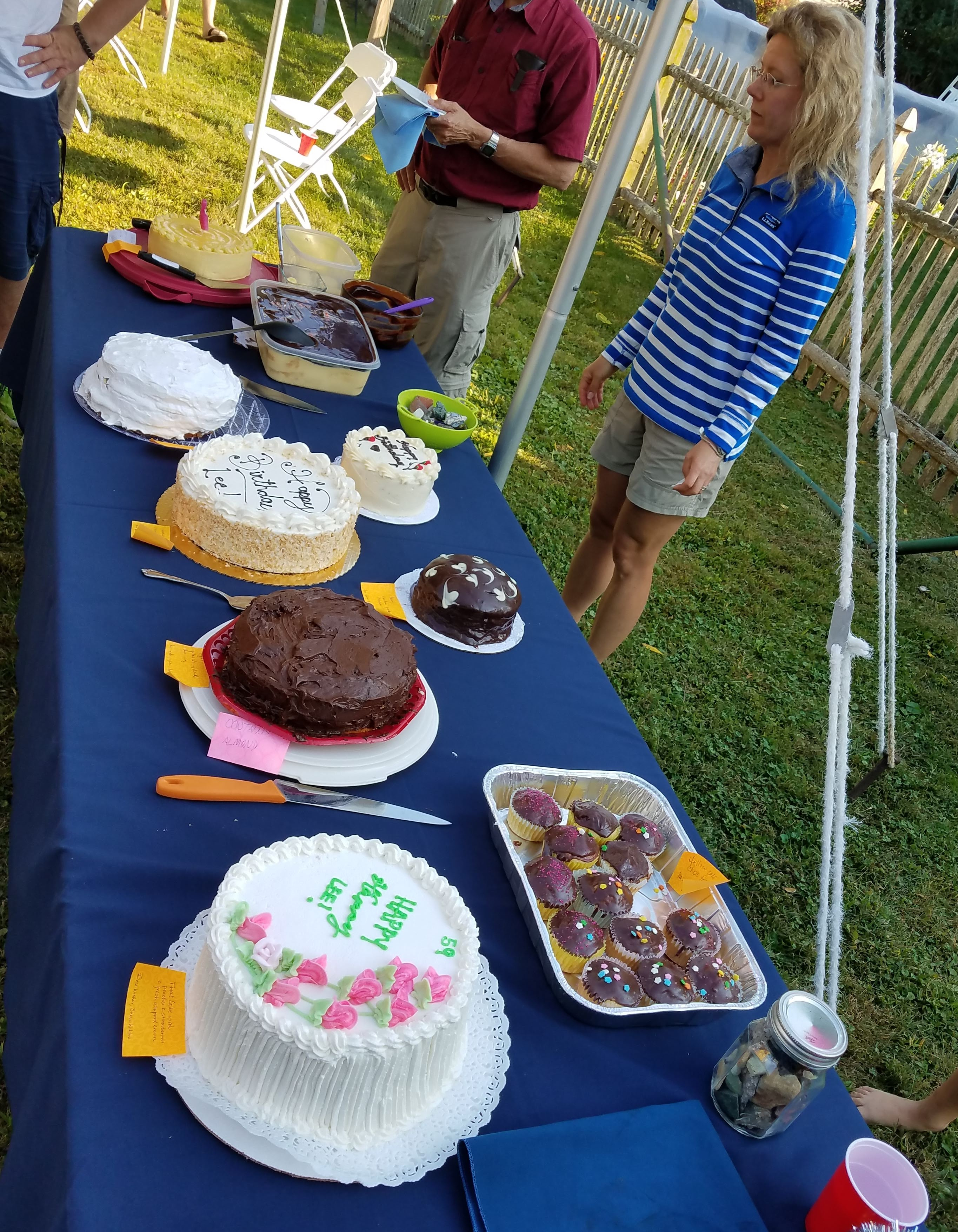
My friends came through, big time! Above is the table full of different cakes, and the author of two of them. I had a tiny slice of each one – they were all so delicious, in so many different ways. Also we had a tent in case of rain but it was turned out to be a nice place to keep out of the sun, and Al decided a birthday is not an elaborately celebrated birthday without helium for balloons and liquid nitrogen for amusement value.

I talked myself hoarse. I visited with people I see regularly and people I hadn’t seen for a couple of years. I introduced friends to other friends; some introductions I’ve been thinking about for a while(!).

Today I am sitting still and reading birthday cards that are making me laugh, and also are making me grateful, and trying not to talk to anyone.

What did I do over the last decade?

  • sheparded/supported two kids through high school graduation, college acceptance, college life and 1.75 graduations (Alice should graduate in the spring. I will still be 59. I’m just anticipating this a little.)
  • Rode a first level dressage test, and got better than 50%
  • built a boat, launched it, rowed it
  • built a boat trailer, and am slowly learning how to back it up
  • designed and printed a tarot deck, and sold 100 copies
  • sold some artwork through a gallery
  • designed and built a city from cardboard – a stage set, but still!
  • worked for five different theater groups building things
  • made new friends
  • kept the old

I’m glad you could join me on this part of the journey, I’m all agog to see what comes next!

Bench Notes

Bench notes are the notes on experiments that I take to remind myself of the steps I took, and what I was thinking, and what I thought the next steps would be. These excursions start when I see a piece of artwork or a scrap of something and my head spins with ideas about how I might translate that to fabric, and whether it would be interesting if I did. This batch started with the images below.

I saw pictures from Guo Pei’s Fall 2019 collection, and I was struck by the construction of the garments. I mean, one model is straight-up wearing a bathtub filled with flowers, which has to be strenuous, while a conjoined dress for two women looks like it could sow dissension between even the best of friends. But the fabrics are amazing, the techniques bear close examination, and these two constructions made a huge impression on me:

The dress on the left, and the sleeves on the right seem to be made from hundreds of fine pieces of silk sewn vertically onto the base garment. The silhouette on the left, in particular, is created almost completely with the shape of the vertical pieces. The idea of sewing something that densely was intriguing.

To begin, I used some pieces of silk dupioni, sliced in wavy lines, and stitched onto straight vertical lines.

Color changes depending on light and orientation. I like the way the edges echo across the piece, like overlapping waves. I forgot that sewing a convex curve to a straight line made the outside edge too short, bending the base fabric. I think the silk needs to be cut more on the bias, to prevent unraveling, and also to add ease to the outside edges.

For a first test, I think I can see some ways to go on the next experiment. Next step:

  • make the stitched edge straight

This makes everything lie flatter, and I miss the movement of the concave edges stitched down with the longer edges ruffling and standing off the page. When I stand the page on edge, instead of flat on the table, the shapes become more interesting.

Some possible next steps then:

  • bias cut
  • make the outside edges more unified – more regular
  • change the weight of the silk? dupioni is fairly stiff, find something more drapey
  • sew in the folded center of a piece? 2x the edges for each seam…

I’ve ordered more silk so I have more raw material to work with!

back to work!

I’ve been working on a series of landscapes based on photographs from friends. Velma Bolyard is a paper-maker, spinner and weaver in upstate NY who takes evocative pictures of her local landscape, and every time there is a barn in the frame I am smitten. My high school friend Jen Dulin walks her lovely dog (and now her adorable puppy) to a lake nearby every morning, and takes pictures of skies and water that make me swoon. I have permission from both to use their pictures, giving me amazing imagery to work from.

With Velma’s pictures I am working on letting the fabric do more work, and sketching crucial details in thread. Jen’s pictures are all about the colors I can put on different kinds of silk, and layers of color.

It is nice to be in the studio again. And in between work with the iron and work at the sewing machine, I work on how to develop my story and what I want to say with my work.

whoooosh

Did your summer go by as fast as mine did?

The last thing I clearly remember was starting the Paintbox season, with fresh paint and a new attitude. As I sit here to write to you, the season finished more than a month ago, at the beginning of August. August was spent finishing up some house projects, and sitting on a beach on an island off the coast of Maine. That beach sitting involved substantially fewer Pina Coladas, and a great deal more grit and beach glass (and also knitting) than I generally associate with the phrase “sitting on a beach,” but it was exactly what I wanted. Also family – I got to go lobstering with my brother and nephew, admire tiny baby lobsters, cook spectacular meals and revel in sunsets.

Now September is almost half over, I’m staring down a birthday on the 27th, and I have turned my attention to marketing. I turn 59 – I am having a large party to celebrate the end of my 50s, and I shall hunker down next year and let 60 creep gently over me. At least, that is the theory.

The marketing part is going a good deal slower than I expected. A lot of the process is writing about what I do and how and why I do it, which requires more introspection than I have applied to myself recently. I’m finding it very interesting to read other artist’s statements and websites, because I can agree, or disagree, and writing those down helps clarify my thoughts on my own process and how I talk about it.


Dream box?


A Friend requested one of these for a friend of his, and called it a dreambox – I think that is a perfectly acceptable thing to call them. Certainly more poetic than I am when I refer to them as “art inna box” or just tiny boxes. My partner is also delighted with them. He says they effuse story… again, vastly more poetic than I.

On Monday I visited Smith College to learn how to use the laser cutter at the Design Thinking Initiative. I had a couple of files filled with digital versions of ideas off the list I wrote down a couple months ago. To our combined delight, everything came out beautifully, from test cuttings out of card stock to things cut from various thicknesses of plywood. The honeycomb in the bee box above are the first things I tried. Below, you can see leaves of various sizes, tiny trees, and a doodle from Alice’s Mineralogy notes.

img_20190506_185250_877


Nearly May

With the warmer weather I have been taking my dad for walks. Every time around the block is an exercise in landscape appreciation – he has never seen forsythia so yellow, a sky so blue, trees doing this extraordinary thing, not that he can remember. Since his memory is failing, he is not wrong, and since he remains kind and interested in the world, we get appreciation instead of recriminations. There is always something to be grateful for.

I have also been spending more time in my studio. I think I am cleaning up, clearing off tables and making space for new things, but I am also uncovering untold numbers of tiny treasures. Which, it turns out, are exactly what I need to put into these tiny boxes. The boxes are the size of an Artist Trading Card, 2.5×3.5″, which means I can use all the ATC I have used for paint practice and stitching practice as backgrounds, and then things seems to -filter- into them. Things that sort of belong together, or that argue with each other. A friend wanted to buy one for a friend of theirs in California, and he called it a dream box, which feels about right.

Happy Spring! or Happy Fall in the southern hemisphere!