machine learning

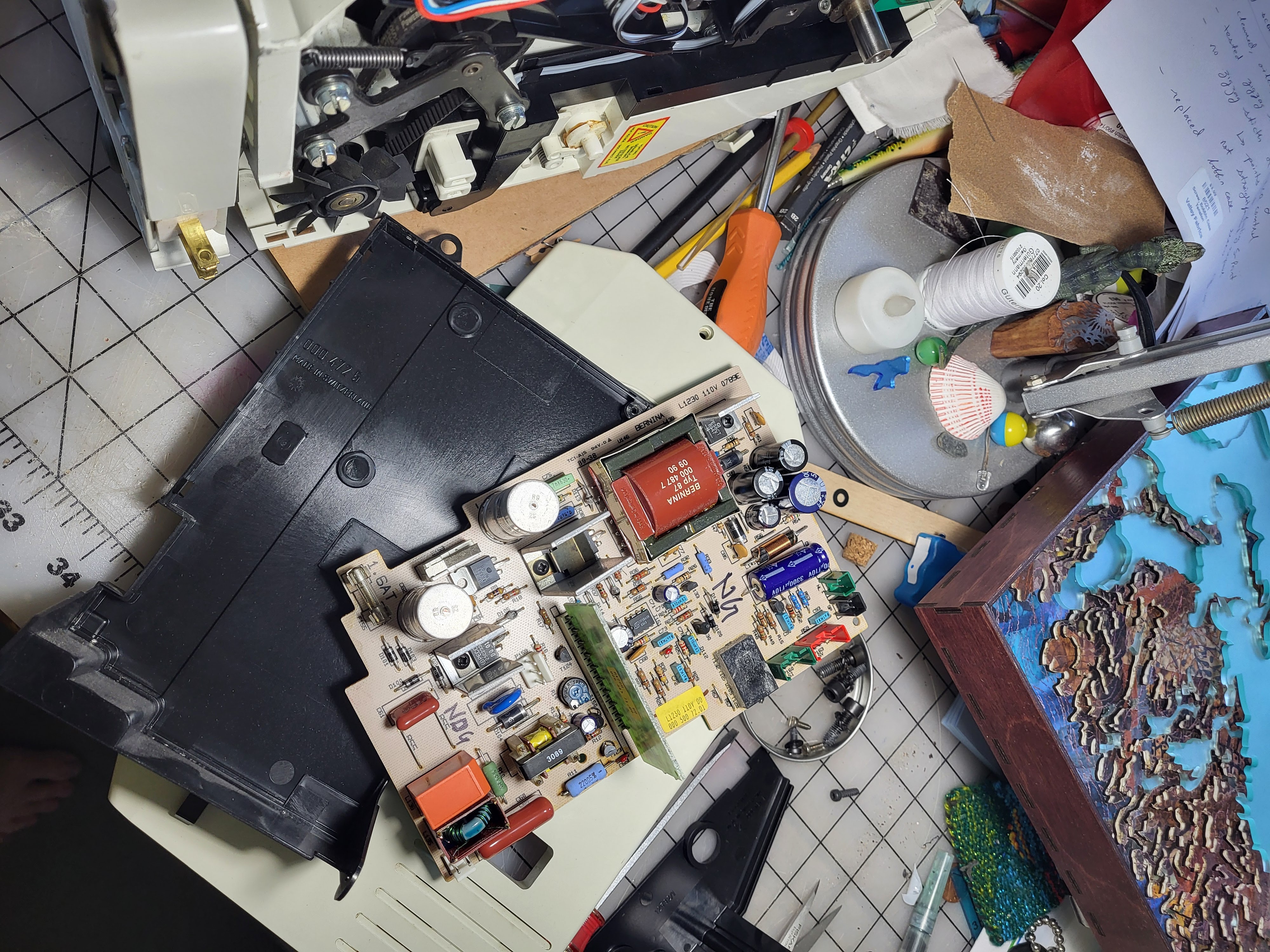
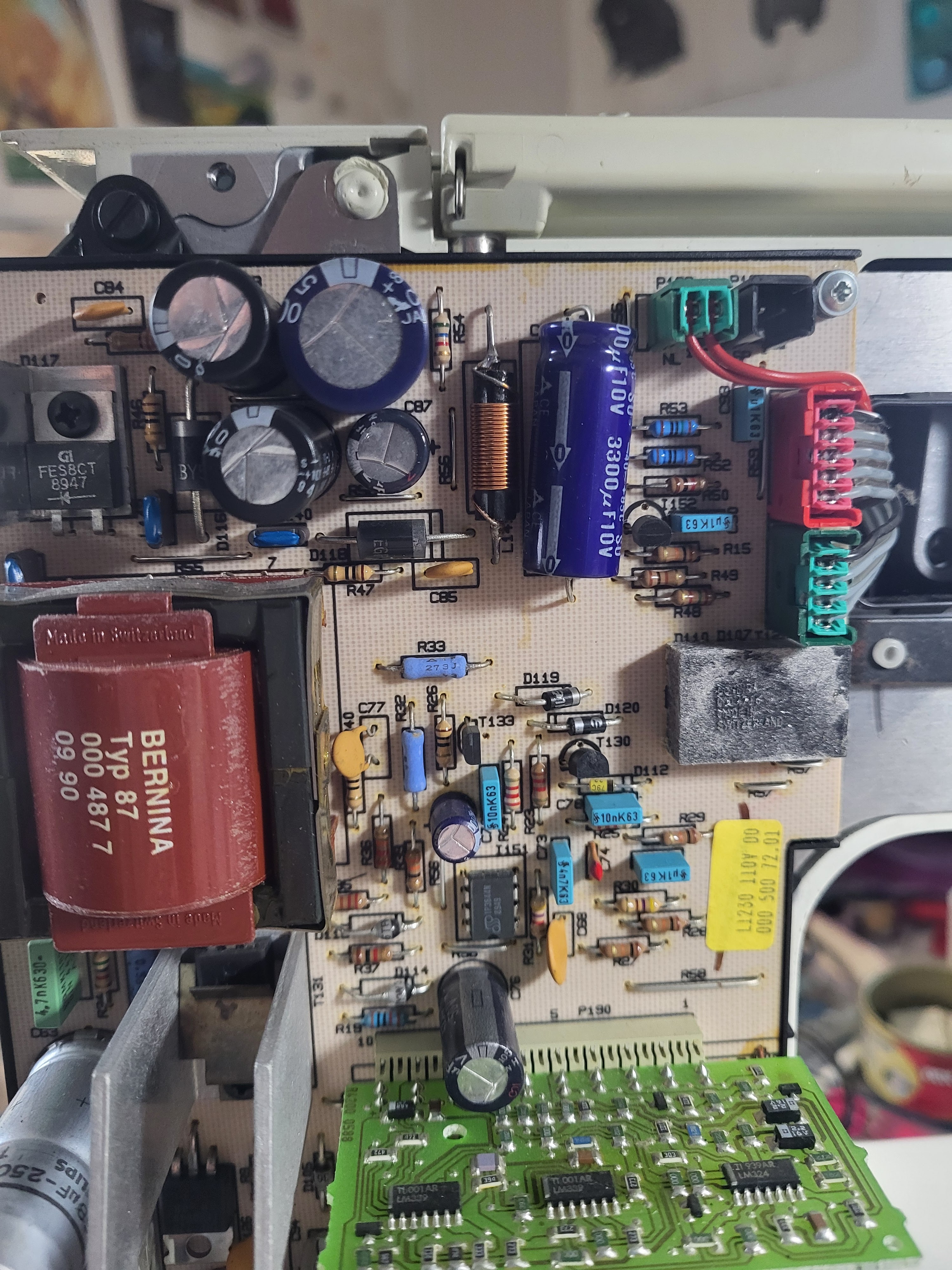
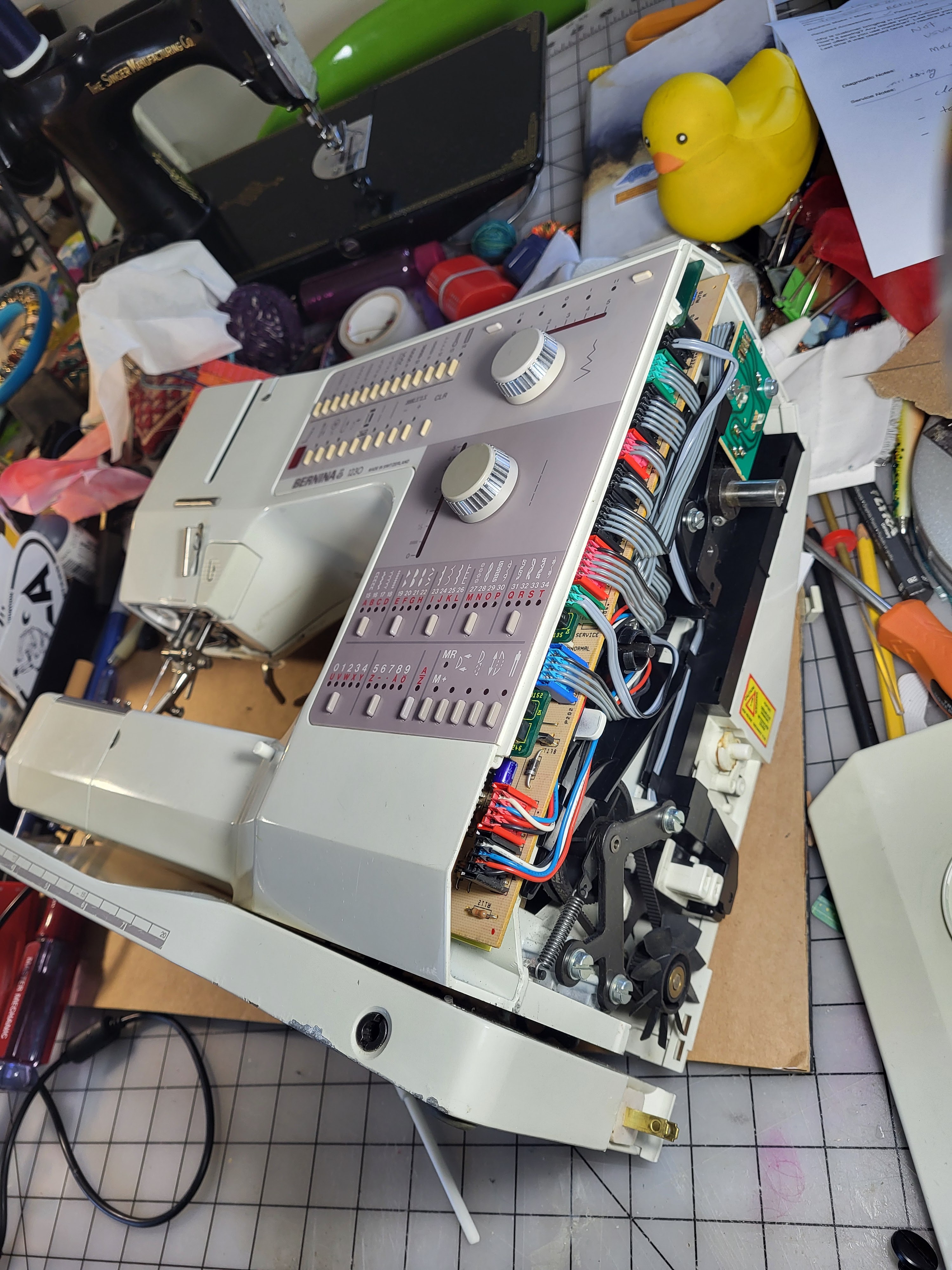
Over the course of the last year, the zig-zag capabilities of both of my beloved Bernina machines has degraded, to the point that I am currently the possessor of three straight-stitch only machines. I took apart the Bernina 1230 to see if I could recognize anything. I found capacitors and resistors and some mysterious things. Consulting with local experts, we concluded the board was probably done. Making some minor tweaks and reattaching it produced no change in diagnosis, so I ordered a replacement board. That arrived yesterday, and I installed it this morning and tested the stitching capabilities with the back and sides open to the breezes. I shocked myself only once, the zig-zag and decorative stitches seemed to be functioning again, so I closed everything up and now have one machine back close to spec. I did manage to cut myself on something though, so either I have promulgated a blood pact with the machine and it is now my servant forever, or I have let loose a demon within it. I’ll report if anything deeply suspect occurs.

we found the whales

We found the whales the third day out of NYC, on the south edge of Stellwagen Bank. There was clearly upwelling with all the levels of a robust trophic web, and there were whale spouts in all directions. The whales present were largely Humpbacks (Megaptera novaeangliae, long winged New Englander) but we also saw Finbacks, Atlantic Whitesided Dolphins, and possibly one or two Right Whale spouts. Endless birds flocked to places the whales were chasing small fish to the surface, and if you watched the birds, you’d find whales quickly afterwards. I could not photograph the wahles – they are mostly in the water, they are far away, and they don’t look like much until they breach, which they don’t do very often. All my attempts look like very small clouds (spouts) or a dark blip in the waves that might b a fin.

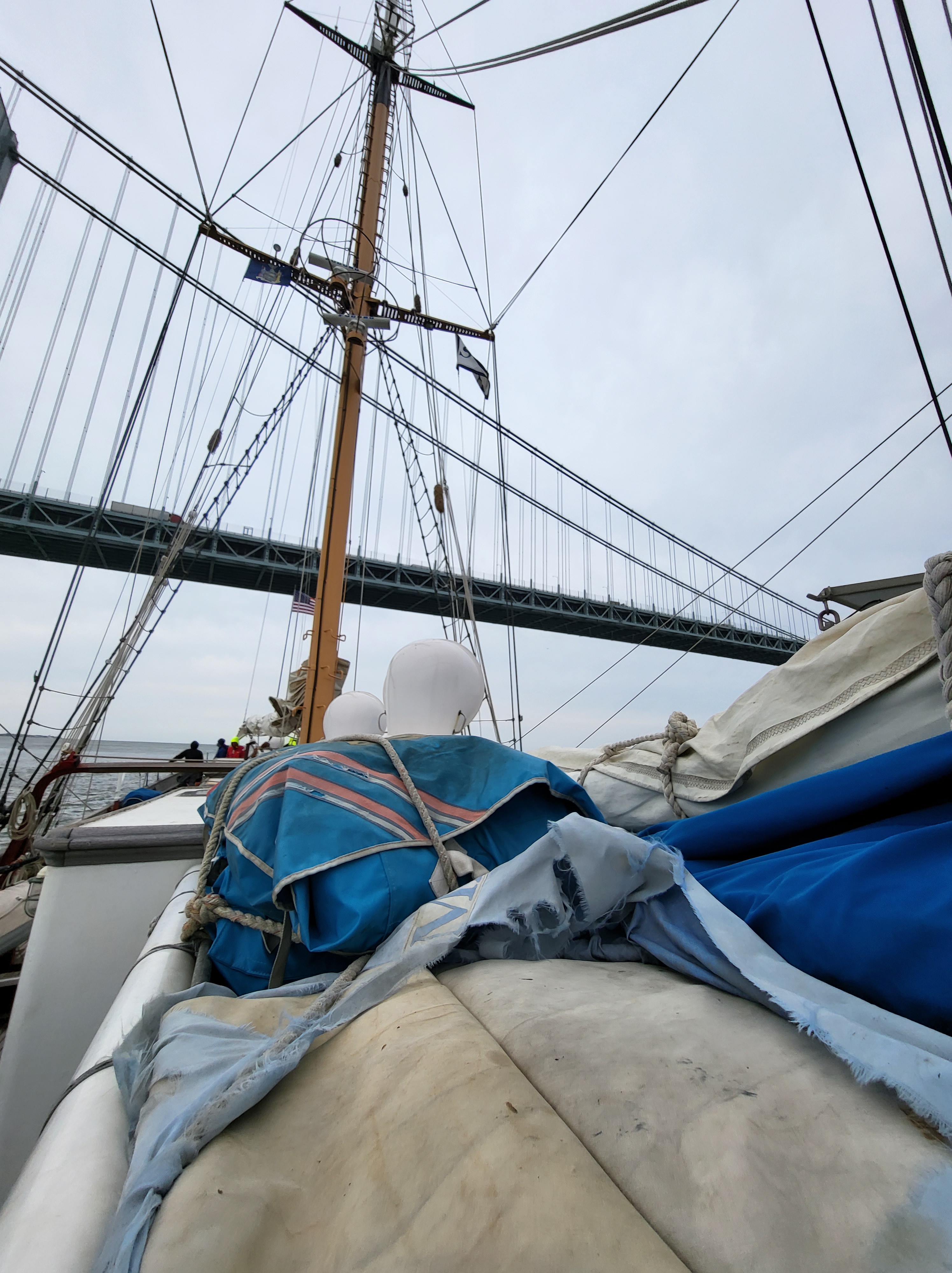
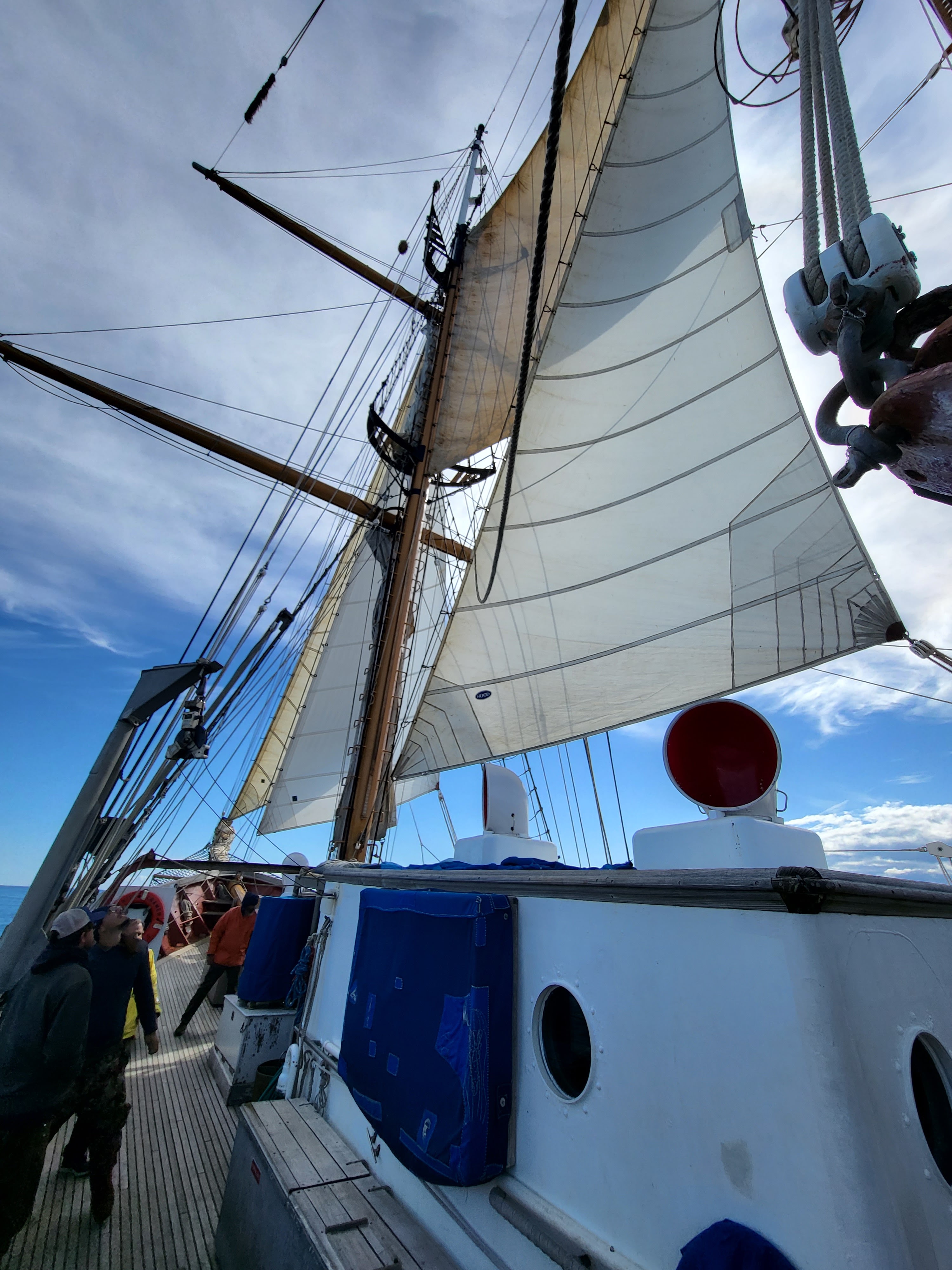
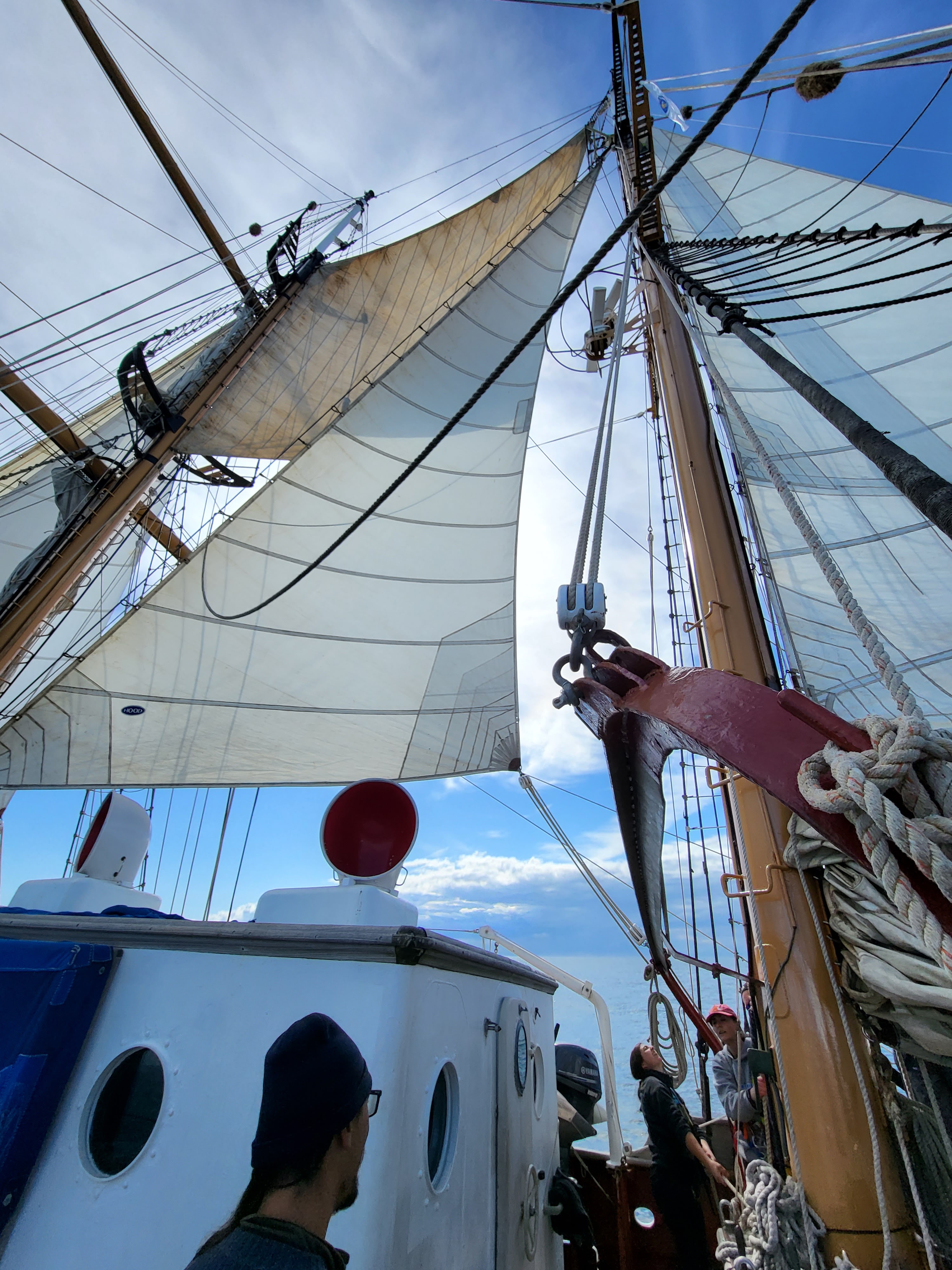
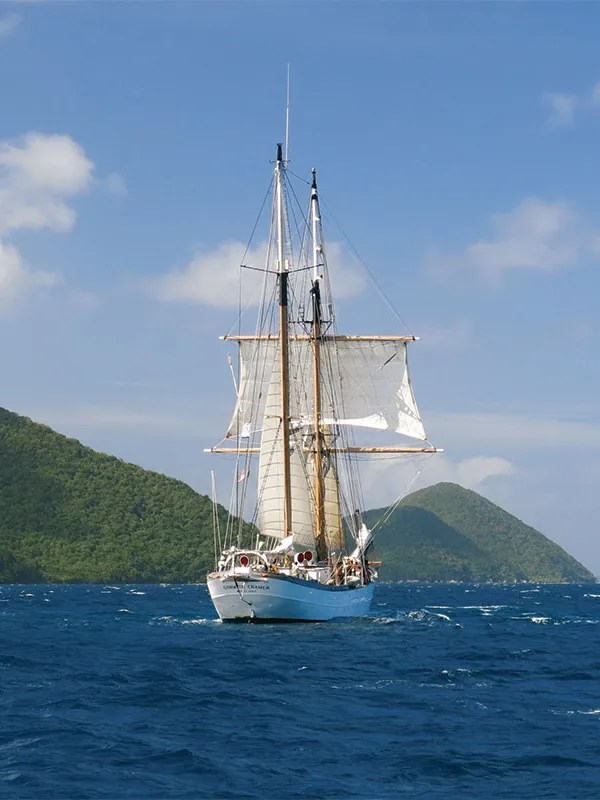
We also managed to use every sail on the ship at one time or another (not all at once, they don’t all work together and some would interfere with others) on this leg. We set my favorite sail, the fisherman, which is the large weird trapezoid set high between the two masts. We took it down again later because the wind died and we didn’t want it flogging itself. Then when we were scudding downwind down Buzzards Bay we set all three square sails that hang from the yards across the ship (instead of the ones that run along the centerline). The bottom, largest one is called the course, the middle is the topsail (I think both of those are in one of the pictures) and then there is a weird little triangular one on top called the raffee that looks like a party hat. I am not at all used to square sails, and maneuvering them was tricky and took extra hands.

I’m home now, sunburned and cheerful. My world still feels like it is rocking gently, but I will be sleeping in a bed where I cannot touch the sides, and no one will wake me for watch. I may do a boat check, just to be sure the cellar has no extra water in it, but honestly I intend to sleep until noon tomorrow.

In which we see no whales

The sailing was, in fact, a lot of motorsailing. Because of the threat of weather, we tended to hammer along with the four lowers set, and a shallow reef in the main – this is enough sail to steady the ship in rougher seas, and add an unexpected bit of speed to the engine power, but it is also enough to feel relentless and loud when it keeps going. We again spent the first two days in the Gulf Stream, so all our forward motion was augmented with a steady 3-4 knot shove from that. This part of the trip we did not heave to, and did not move inexorably north, completely sideways, at four knots. Instead we forged ahead more or less due north at, generally, roughly seven knots. There was one day where wind and current combined to get us to nearly 9.5 knots without the engine, which was deeply gratifying. Honestly, everyone perked up and was pleased with themselves that day. It mostly made up for a pretty miserable previous day where two of us got massive migraines, and the ship was pitching and heaving and wallowing in the crossing seas of winds from the north roughing up the current heading that way.

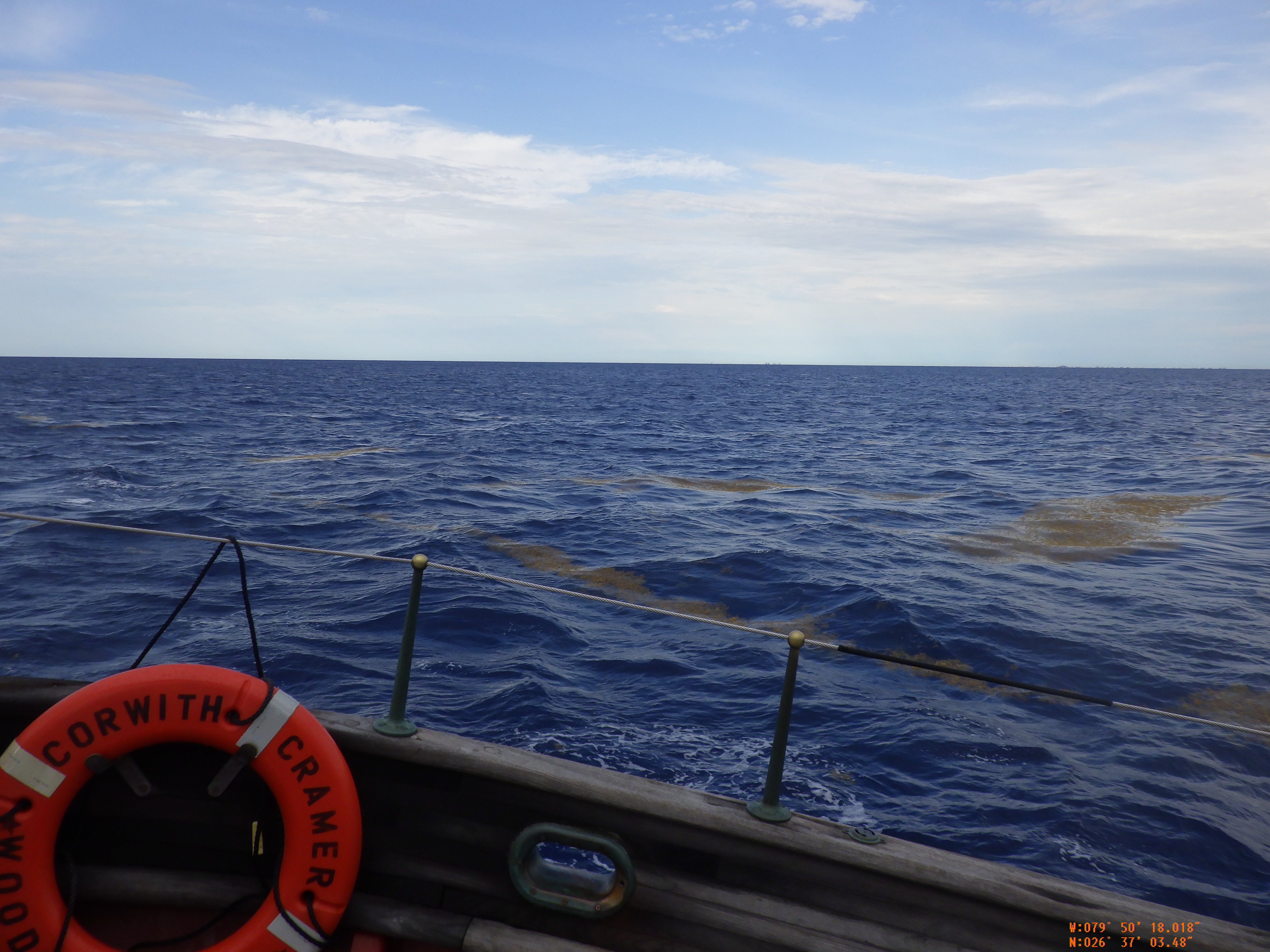
The Gulf Stream (did I say this already?) is a ridiculously lovely clear blue-purple color. I was deeply grateful to the instruments in the lab, and I got so attached to them that the science staff taught me how to do the hourly reports. I can say with authority that the Gulf Stream is substantially warmer and saltier than the US coastal waters, and that there is less Chlorophyll A in it than in coastal waters, and that the planktonic load is lighter. I got one of the visiting specialists interested in the edges of the Gulf Stream too – and we were watching the instruments and looking back over the readings trying to find where and when we’d left it.

This is where I admit that I had thought of the edges of the Gulf Stream as being much more definite – in/out, yes/no, here/there. And what was brought home to me, and what I think will inflect my thinking a lot about the work I want to make about the Gulf Stream, is that everything in nature is a gradient. There are nearly no hard lines. I was talking to the Center for Coastal Studies man and musing about lines in nature and my own words teaching about GIS came back to haunt me: raster tends to be best for natural phenomena such as elevation, rainfall, etc., while vector representations are generally manmade things – political divisions, roads, power lines – OR manmade distinctions, like contours in elevation. I was looking for a line, a manmade distinction, and what we traversed was a gradient. A very steep gradient, but it was still sliding between one thing and another.

This reminder about gradients rather than hard lines has opened a whole new way of thinking about representing the Gulf Stream in the pieces I am planning – I am awash in notes and theories and it feels exciting.

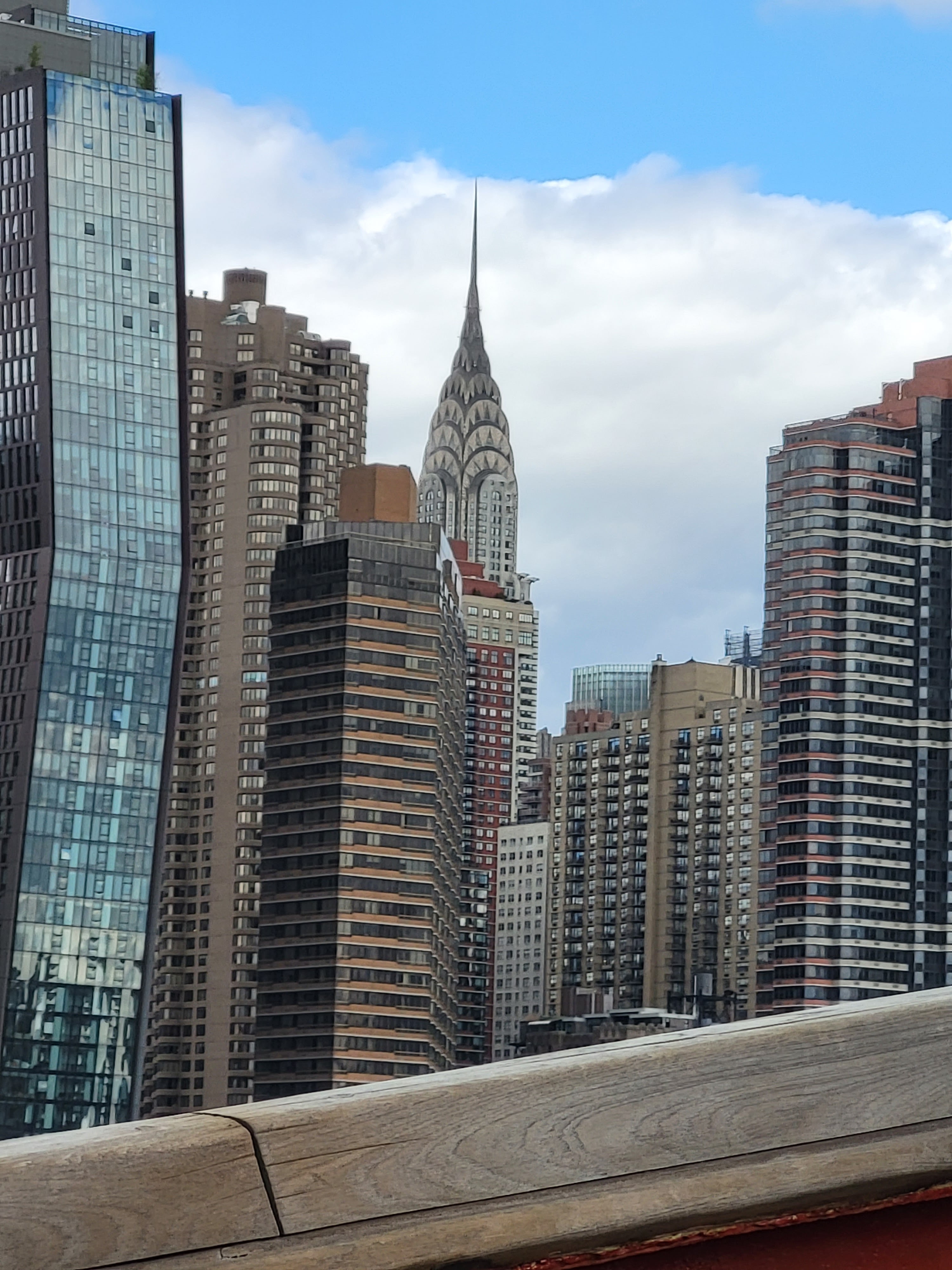
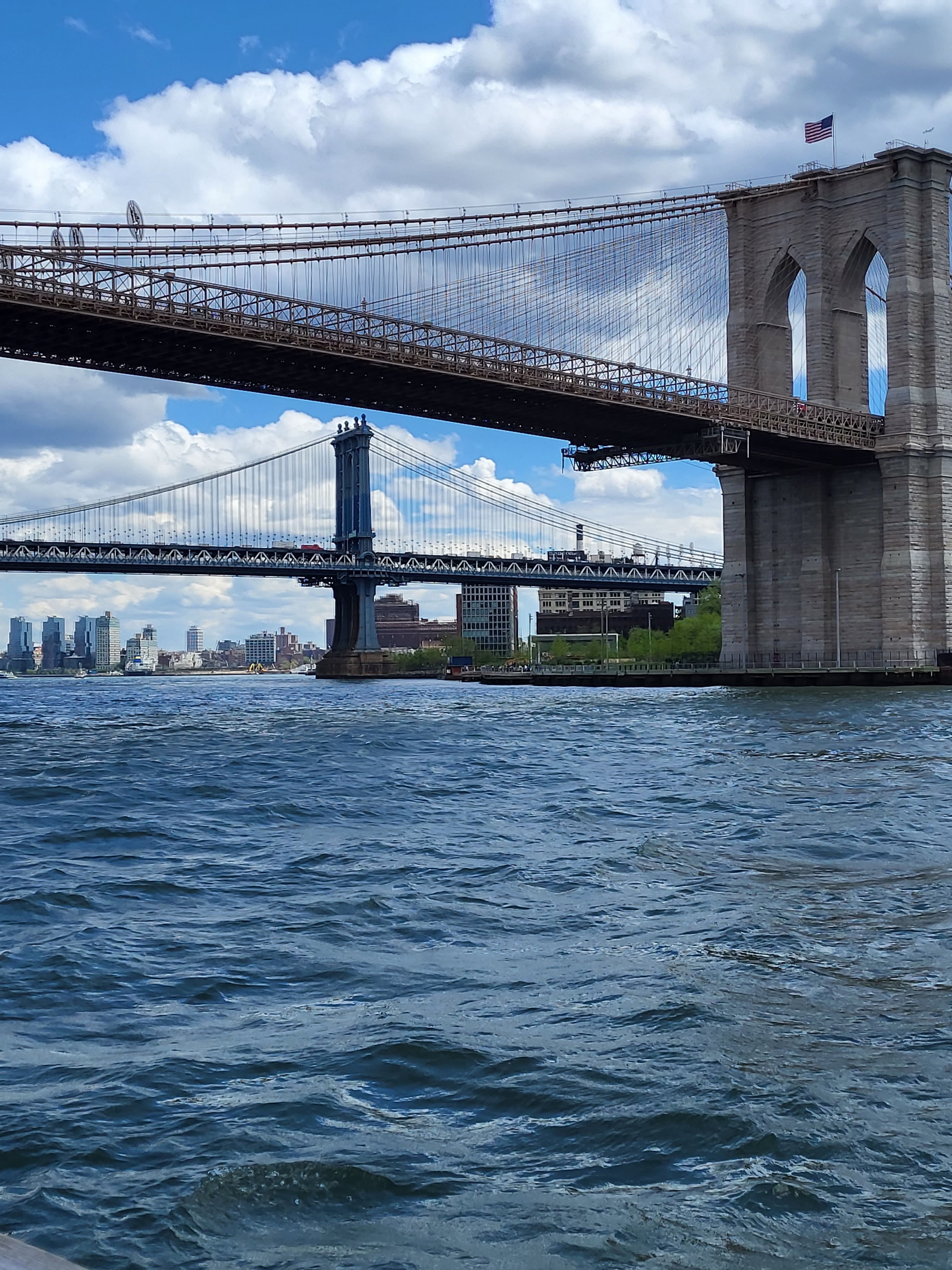
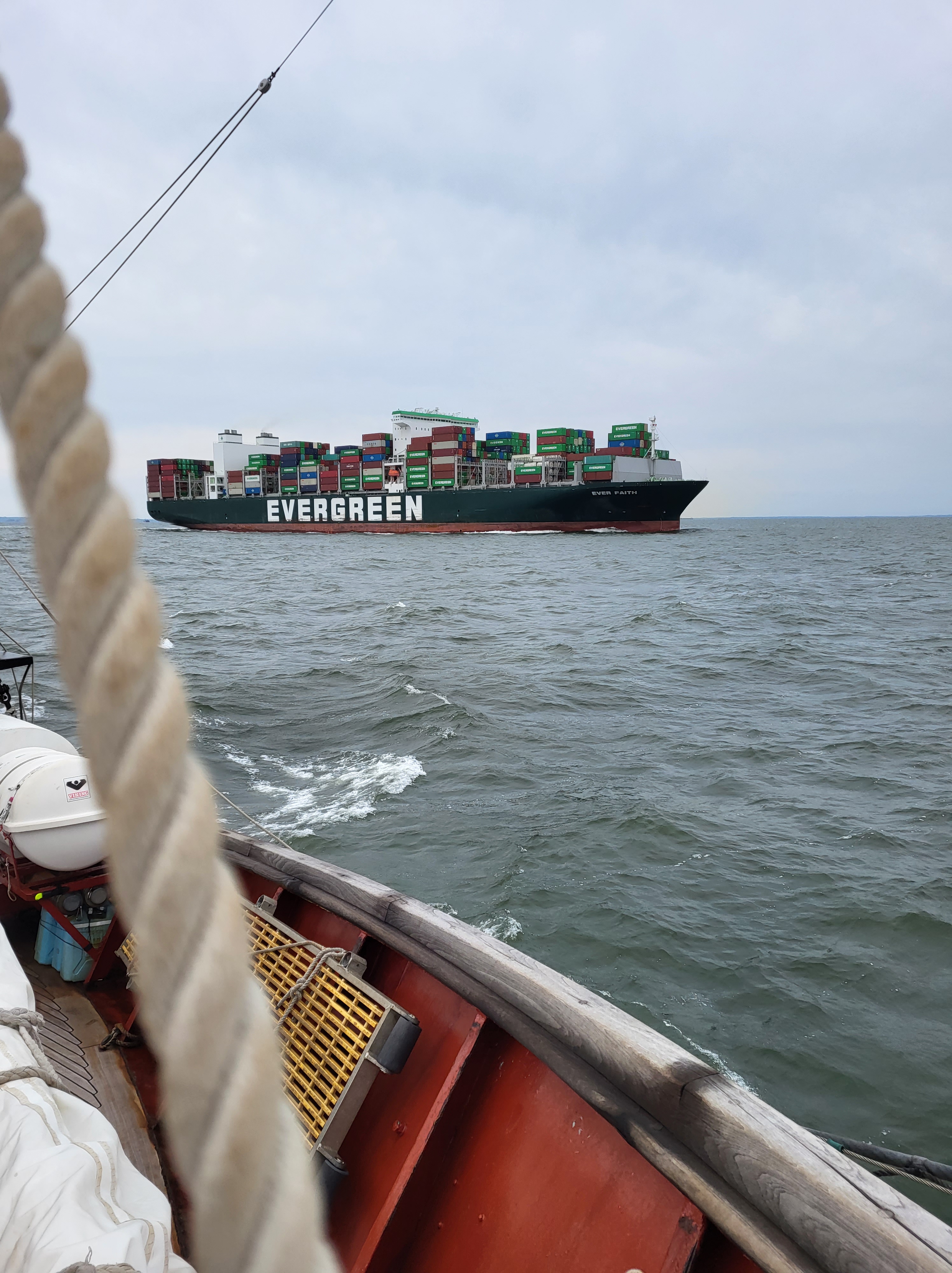
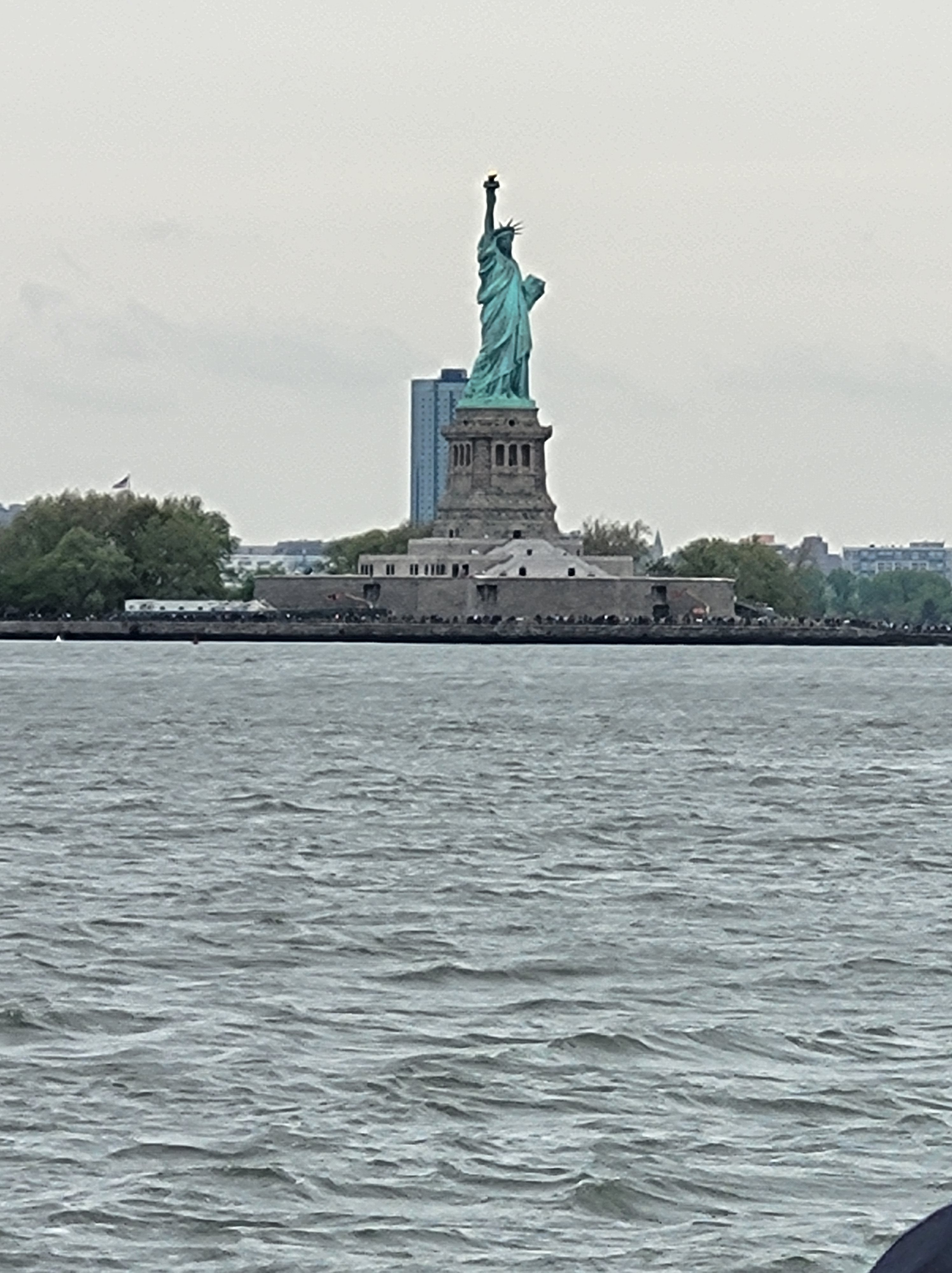
This morning early I was awakened by a large noise, and went on deck to try to see what our approach to NYC looked like. From fifteen miles out, it looked like a field of oil tankers – I could count ten in the pre-dawn light, and there seemed to be more ship IDs on the plotter. NYC itself was a hint of glimmering lights juuust over the horizon, and I am still not clear what I was looking at. As we approached the Verazzano narrows, we pulled in behind two oil tankers headed to NJ for processing. While we were in the channel we were overtaken by one of the Evergreen fleet (yes, I was absolutely hoping it would run aground) and it was reported that when asked how he would like to meet (the polite terms at sea for “which way ya going?? Ahead of me or behind me?”) their captain replied “you go one side or other, I take middle” and they steamed past us at an astonishing speed.

We pulled in just in time too – a north-easter is brewing, and it is cold and wet and rainy – better to be in Brooklyn than on the high seas. Even better to have new long underwear to keep me warm for the next leg!
Stars in the sea

We spent three days in the Gulf Stream driving and being carried north. We accomplished some science, we deployed some ROVs (remote operated vehicles) and fixed the problems that came up.

I am on this ship to think about and experience and get information on the Gulf Stream. After looking at many rivers on the land, the image of the Gulf Stream looked so like river in the ocean to me that I wanted to see it, in person.

Being in it is remarkable. The color is the most dramatic change – it goes from green and cloudy to deep purpley-blue. The speed is not noticeable except with gps tracking. With that, I knew we were always making three knots even when we we not under sail or power.


I made a point of being on deck when we exited the Gulf Stream. The night was calm, the seas flat to the point of reflecting the brightest stars. The change I could see was the sudden appearance of bio-luminescence in our wake. I’d been hoping for that all trip, but the Gulf Stream is too hot and too salty and too devoid of nutrients to support that kind of life. The coastal waters do, and the transition was quick. I pointed it out to everyone on deck at that point and requested time as lookout so I could hang over the bow and stare at the glowing froth as we plowed through it (I still checked the horizon for traffic, I have some standards). The propeller was making a deep glow in the ocean behind us, a solid six feet below the surface and looking like the Milky Way under the sea. Flying fish were leaping out of the water ahead of the ship, and making sparking trails where they left and re-entered the water. It was very very fine.

Take to the SEA

I’m going to be on SSV Corwith Cramer next month, in temperate waters (Maimi, Florida to Woods Hole, Massachusetts), and then in the fall, I’ll be on this ship:

out of Svalbard in October.

I could not be more excited! I am using waaay more than my fair share of exclamation points!! I’m going to Take To the Sea!

What is a mistake, actually?

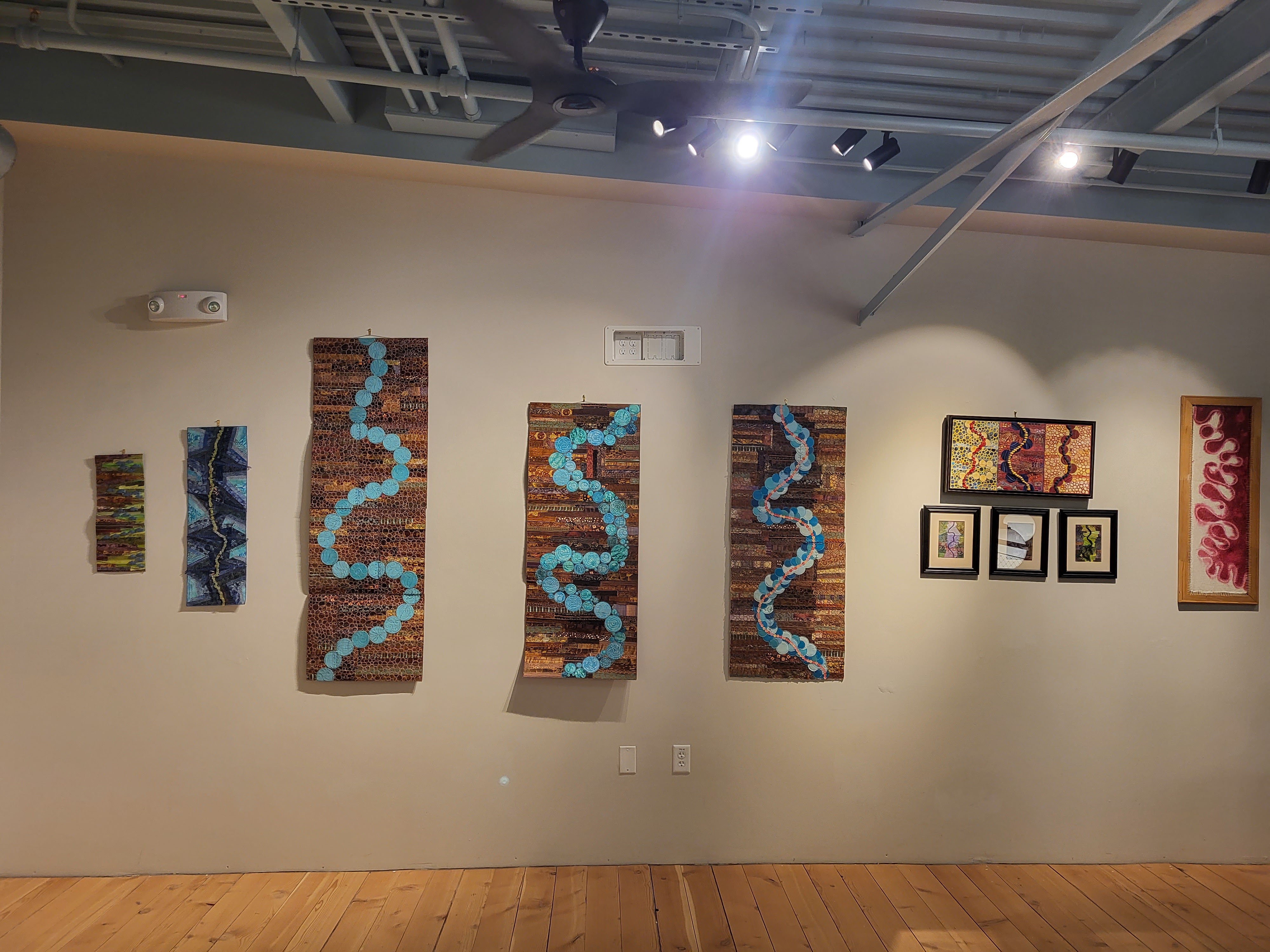
The reception last night was a mad success! Thank you so much to friends who showed up, especially friends who came in from a distance. Thank you also to strangers who came in as a part of Northampton’s Arts Night Out and left lovely comments and asked fascinating questions.

My favorite question of the night was “what if you make a mistake?” and I am ashamed to say I just laughed. When the querent and I walked over to one of the bigger abstract river pieces, we looked for something that might be a mistake. What I was trying to tell them is that when there is no detailed plan, there is a lot of room for things to happen, and very few of those things are mistakes in the usual sense of the word, that is, an imperfection that forces the maker to undo or reject the piece. There is so much thread, and so much motion in most of my work, that even in places where I see my own hesitations, they are not readily visible in the work as a whole. Which means the hesitations, snarling thread and weird edges are not things that render the whole piece somehow incorrect – they are the things that make the piece individual and handmade, and ultimately make it art.

It is a completely legitimate question, and I think a common one asked of artists, and makers in general, but I think it misses the point of art, and of making things.

Full of incident

Yesterday Cathy and I installed the exhibit at Northampton Center for the Arts which was both easier and harder than expected. I absolutely could not have done it without help (Cathy, I owe you much, much chocolate) – the combination of blank walls and high ceilings meant I needed help ,measuring and reaching. But also, I had chosen to bring a handful of smaller works along, and hanging those guys was very, um, time-consuming. BUT! It worked, and it looks amazing, and here, have a poster:

And if you’re local, come to the reception. If you’re not local, come for a visit and lunch, and I can give you a personal tour. This offer good only through the month of March, because after that, I take to the sea!

Today I spoke with Sea Education Association about scheduling my trip with them as Resident Artist this spring. I’m going onna BOAT!! I am SO PLEASED! I’ll be sailing on SSV Corwith Cramer, a ship named after one of the founders of SEA, and someone my parents were friends with.

And to round out the things that are happening, the living room is getting painted before the (reupholstered) couch returns home next week.

I mean, that last is strictly personal info, but everything all together feels like a lot, you know?

seasons, inventory

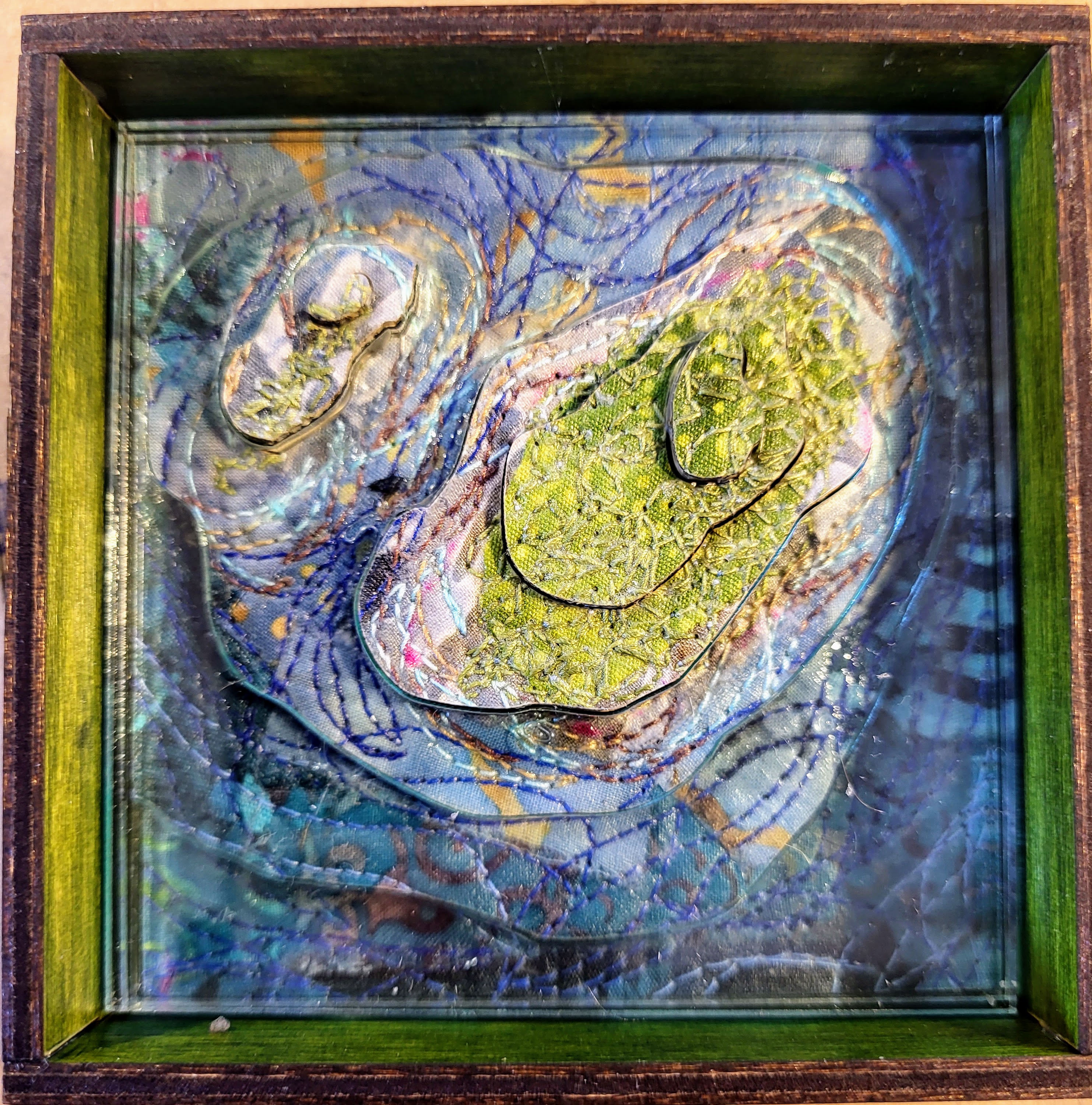
Some of the new little boxed landscapes and seascapes I am working on. I have a trunk show coming up at Sawmill River Arts Gallery on February 25th, so I’m working on these little guys right now. These rivers have fall colors going on, with more showing winter, spring and summer colors. They are 2×4 inches (50x100mm). The islands and coastlines are mostly summery, they are 3 inches (75mm) square, all cozy in their little boxes.

The coastlines are all pieces of Maine, simplified. The rivers are short sections of the northern Connecticut River, even as they are also things that all rivers do in areas with little slope. I am ridiculously fond of them!