high water
April 23, 2015
partner, parent, artist, knitter, sailor, cyclist, sketcher, house painter, set designer, safety officer, itinerant equestrian, kite flyer, questions?

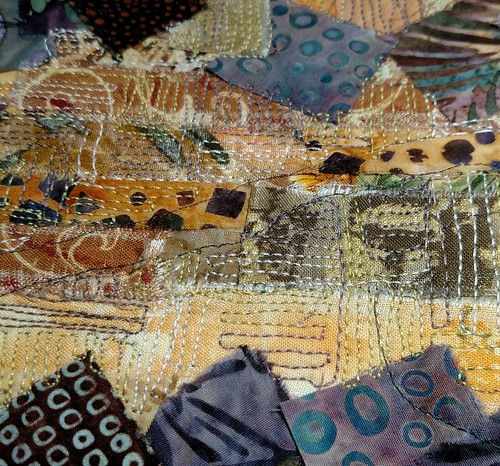
I thought I needed more brown fabrics, but in fact, what I needed was to organize and dig through the fabrics I actually own. I found this array of browns and tans, some with gold – I was particularly hoping for brown with gold so it was gratifying to find these pieces.
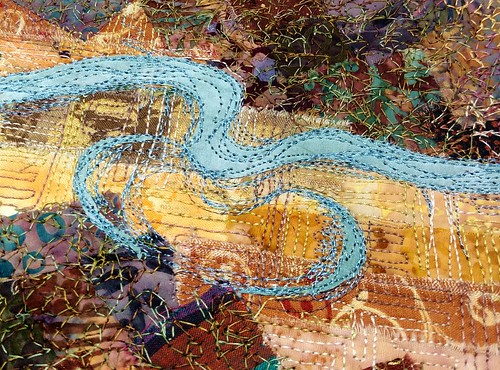
Then I finished getting the colors down for the spring river piece, and starting stitching on the fields. The outrageous thunderstorm last night prompted an outburst of blossoms and baby leaves all over the trees, so I need to get moving on this to catch the part of spring I am thinking about.
This past weekend I ran away from home. I did not answer my phone or stay with family or friends, I just went away. It was lovely!
What took me to Portland was a class by an online friend, Velma Bolyard. I’ve been following her blog since I started mine in 2007, and we’ve emailed privately and sent actual objects back and forth. I leapt at the chance to see her in person, and to see what she had to say about contact printing using foraged materials and metals.
The class was held at the Southern Maine University Portland campus, in a beautiful new building. It was organized by someone with extensive background in book arts and paper who also possessed a sturdy capacity to organize. The day went beautifully.
Contact printing is far simpler than I expected. The process consists entirely of three steps: collect, arrange and cook. Foraging is used loosely to indicate it does not matter where you find the material. I pulled leaves off trees, ferns out from under my house and fungus from a neighbor’s log. One woman brought all her old spices and dried food, several people brought seaweed and other local flora. And THEN we all traded around.
Placing the material on the paper was not so hard as folding the paper to keep all the bits inside. Once the paper was folded around the plant material, it was clipped onto pieces of flat metal. The combination of metal (mostly iron and copper, in the form of can lids and pipes but also a big handful of pennies) and plants would color the paper in all kinds of unexpected and interesting ways. One of the most coveted metal pieces was a flattened box grater – all the holes made compelling patterns on the paper. My best find was a bottle-cap that had been in a parking lot over the winter. It made a great little corrugated circle on one side and a rusty blob on the other.
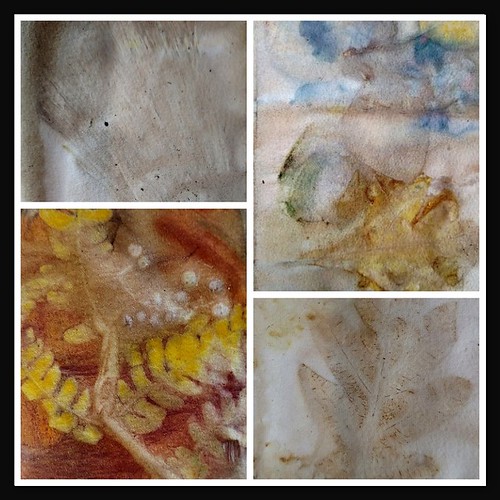
From there, you just boil it for a while. You could steam it too. But really – an hour or so, and we fished out the wrapped bundles of paper and unwrapped them and found these beautiful colors and shapes. If control matters to you, and you want a particular outcome, this might not be so gratifying. If you are willing to explore the garden, freezer and grocery store with an open mind, there is some good fun to be had!

I just finished the second tree. I will post a trip report soon.
The short story is Portland! Velma! Contact printing – on paper!!! but it is worth fleshing out a little.
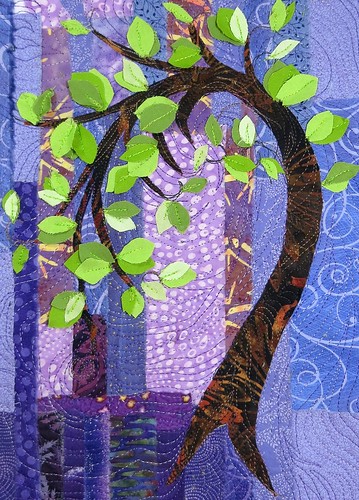
This tree is well ahead of the actual trees outside my window. We have not even reached the brilliant green haze part of spring, where the trees bloom and pollen is everywhere and tiny tiny leaves start over all the deciduous trees. It will happen. Eventually.
I have packed materials and foraged greenery for a class in printing from wild things. When I’ve printed from nature before I have used paint and made prints. In this class we will learn about what things already have pigment that can be set set using scraps of metal (found along with the foraged greenery I assume). I will report back! With Pictures!
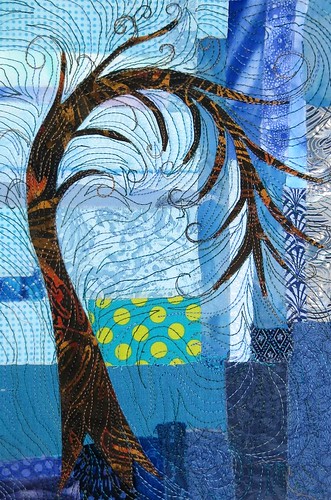
This is not quite done yet – it needs either leaves or blossoms scattered across it, and stitched down in a way that will let them floof (that’s a technical term) out away from the flat surface.
I realized when I’d made the second one that they looked like Truffula trees, from the Dr Seuss book The Lorax. Well, sort of.
The moral of my story is that it has taken me a while to focus on the next big piece, but I was obsessed with these today, and worked on them more or less all day, and it was fun. So I am glad I temporarily put the more serious piece aside, and I swear I will work on it next, but I think I needed to goof around a little!
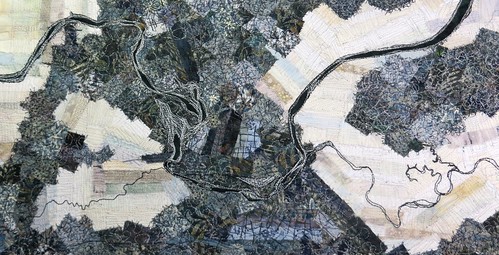
Finally, now that the melting has started in earnest, the end of the long icy winter piece.
This is one of the more realistic geographical pieces, related to the summer river through Hadley I made for a show last fall. This depicts a section of the (mighty) Connecticut River from French King Rock through Turner’s Falls and into Sunderland and South Deerfield.
North is to the left, the river flows south.
A couple people last month asked me why I work on the school productions. They note I complain a lot, and sound stressed when I talk about how the show is going. When even my father asked me, I realized I need an answer, and so I have been thinking about this during last week, when we were getting the show ready to go, and this week when I have been recuperating from the effort.
The short answer is that while some parts drive me crazy, I like many aspects of working in high school theater. Making things that people use is deeply gratifying, whether that thing is a computer program, or a quilt or clothes or toys. Seeing my work used makes me absurdly happy. Designing and building sets for a show feeds that gratification because it provides an environment for the actors that supports them emotionally as well as physically, so they can do their work to the best of their ability.
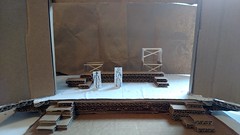 The design process is generally solitary, but design for theater requires that the sets be build-able, useable, and fulfill the requirements of the script and of the director. I start with models, because describing brainstorms to people doesn’t go well, and my drawing is not up to the perspective involved.
If my overt duties are designing and building things, and teaching the kids I work with those skills, I also have a covert agenda. I hope I am also demonstrating how to use tools, how to work in teams, how to solve engineering as well as social problems, how to be capable and kind. So I teach about how tools are used, and hand drills and hammers to everyone. I can empower the meek, rein in the thoughtless, and encourage and follow the wise, if I do it right.
Can I take a moment to talk about kids these days? I love them. I think the teenagers I know and work with are astonishing. They behave better with their peers, and show more kindness towards their adults, than I remember applying when I was their age. Faced with challenges and diversity, they are crafting a much nicer world than the one I came of age in. I know thoughtlessness and even unkindness exist but they are harder to find now. I look forward to the world when they have control.
When we work together, we get a lot done. They require insane amounts of pizza and donuts, but they also supply insane amounts of effort and enthusiasm.
Eventually, the show happens. Before the show happens, production week happens. That part is profoundly stressful, but it is hard for everyone. The integration of scene shifting and light and sound cues with the choreography and blocking the actors and director have been working on for months is finicky and effortful. But once the initial integration is accomplished, settling the varied pieces into their proper places, polishing the production until it runs cleanly and well can be gratifying. And by that time it is mostly out of my hands. With the build crew the set was accomplished, with the light crew, the lights were hung and focused and colored, the sound crew makes sure everyone is heard… all that remains is to keep the edifice upright until the end of the run.
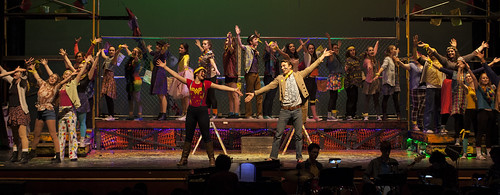
What we do is a large piece of impermanent art. We build a huge, rickety clock-work construction; we wind it up, and it unwinds in a real-time, live performance. And the next night, we wind it up again. It is big, and complicated, and has many moving parts that interlock and depend on each other. It interests me that the thing we build is almost equal parts technology and humanity. And it amuses me that if we the technologists do our part well, the audience won’t notice it. It delights me to provide a platform for this level of joy:
And I shall tell you a secret: my absolute, most favorite part is taking it all apart at the end of the show, reducing the construction to parts ready for the next one.


The tech before the storm, or something like it. Scaffolding, chain link fence and platforms at various levels, all working to support the actors and give them an interesting environment to work in. The auditorium is remarkably quiet and empty as we set cues. The quiet will end Monday when the sound hardware comes in, and we start running the show end to end to end, getting it smoother and faster.

a close up of a 2×4″ section at the north end of the piece – the river is in place, and needs definition
In other news, liquid water yesterday in the afternoon (photographic evidence)

temperatures well below zero Fahrenheits last night, and liquid water again this afternoon. The horses are shedding, the birds are singing, the days are getting longer, and hope is starting to spring again. Or maybe that is just spring, springing again.
 Lee Thomson