
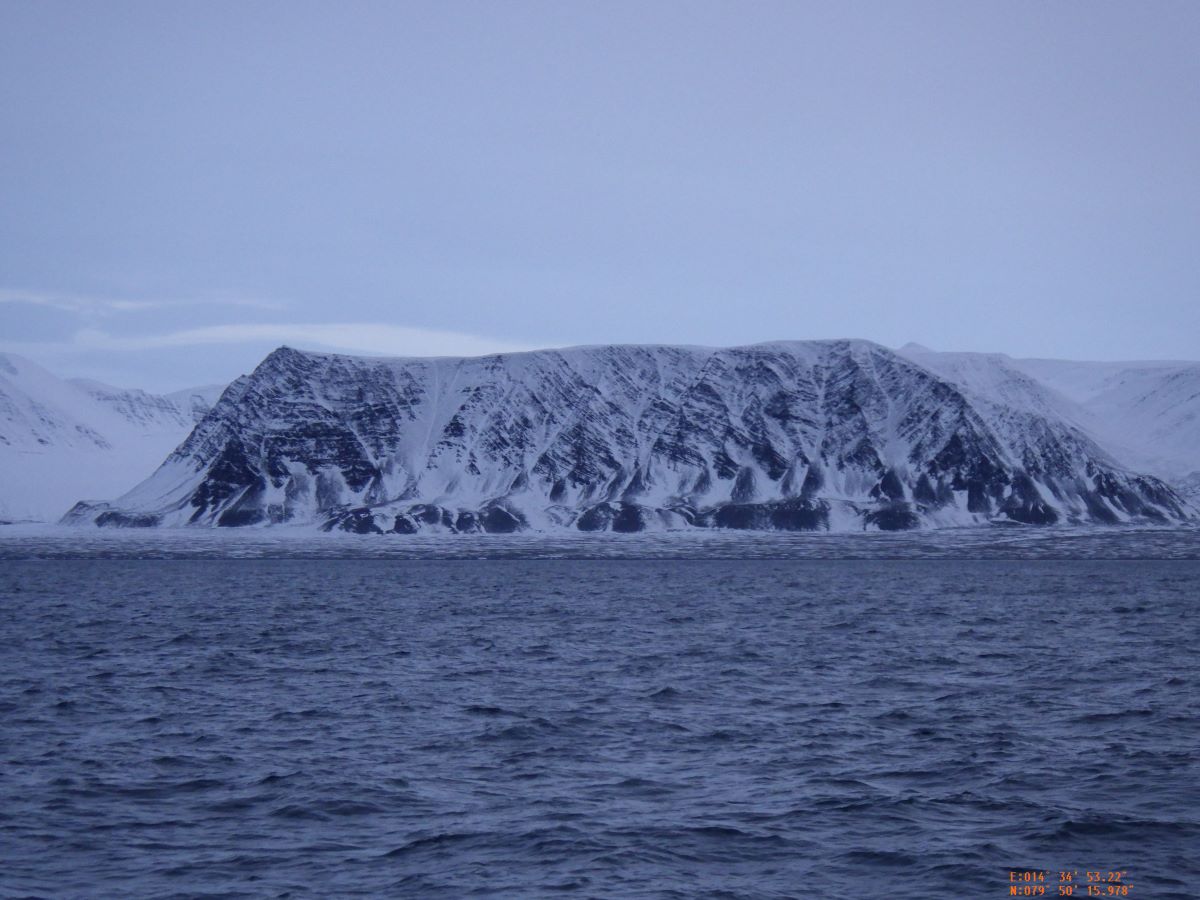
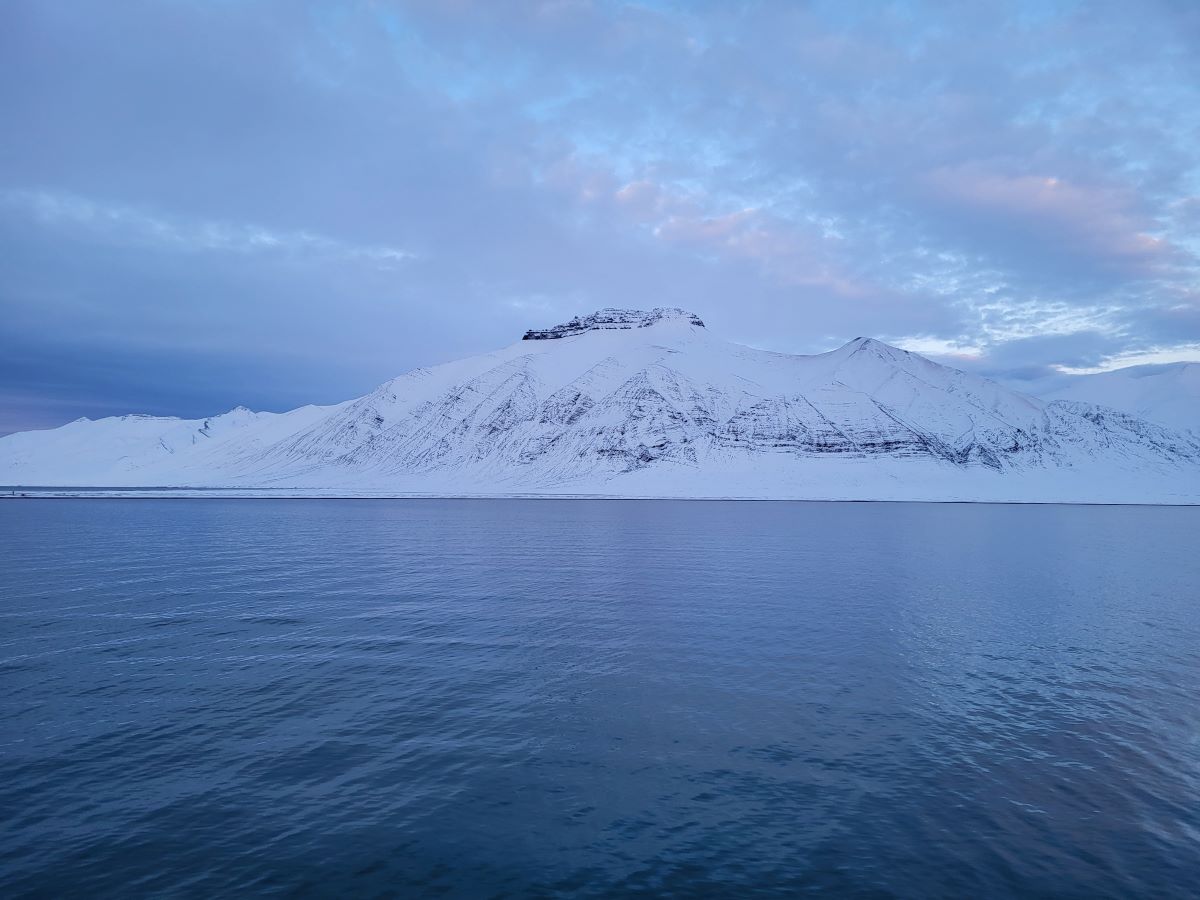
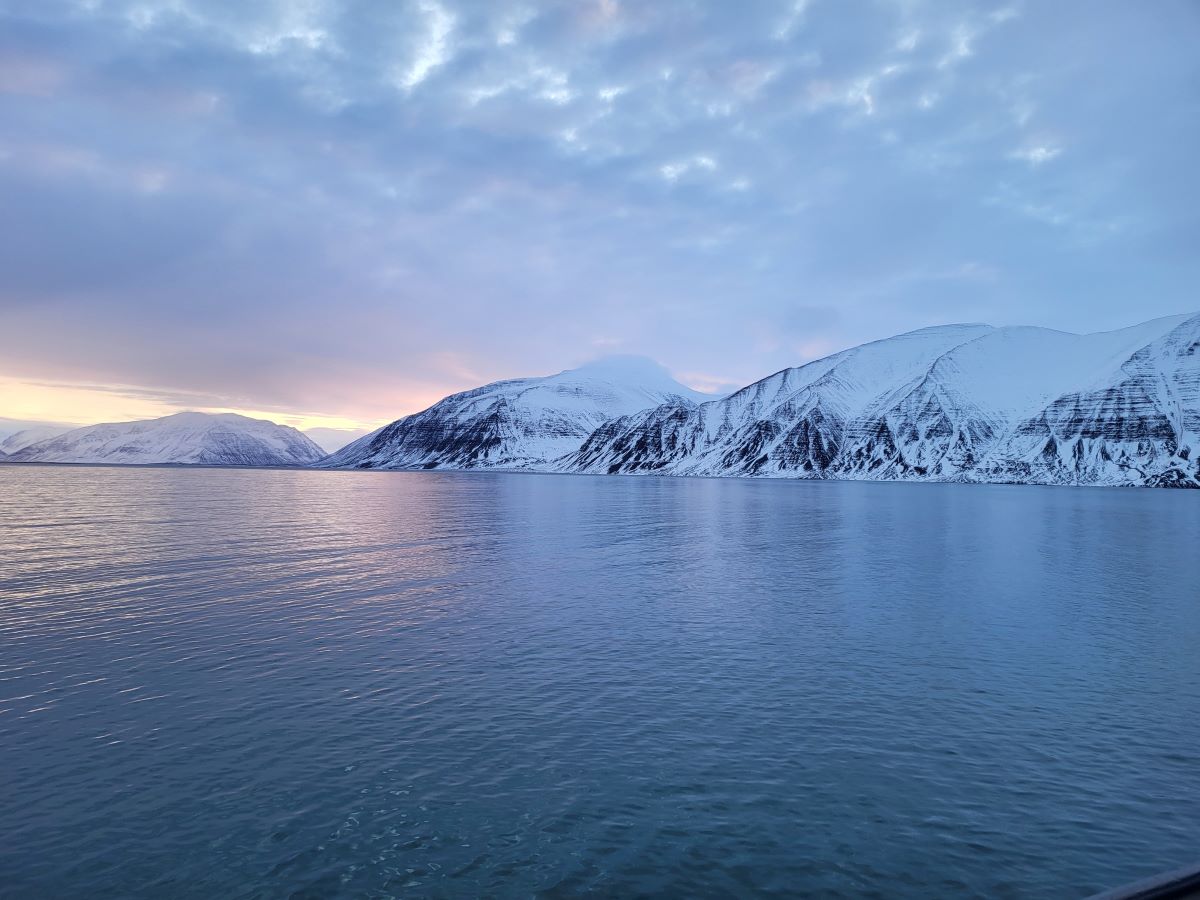

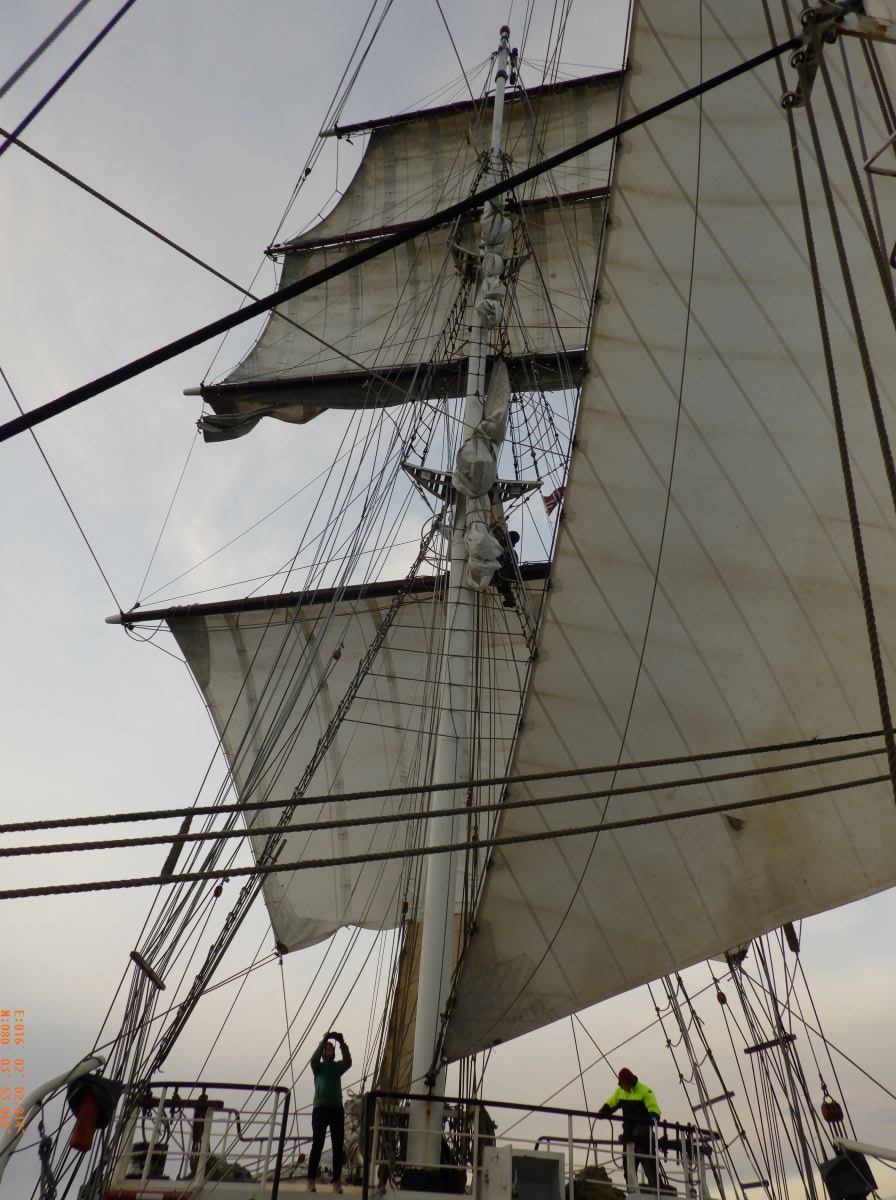

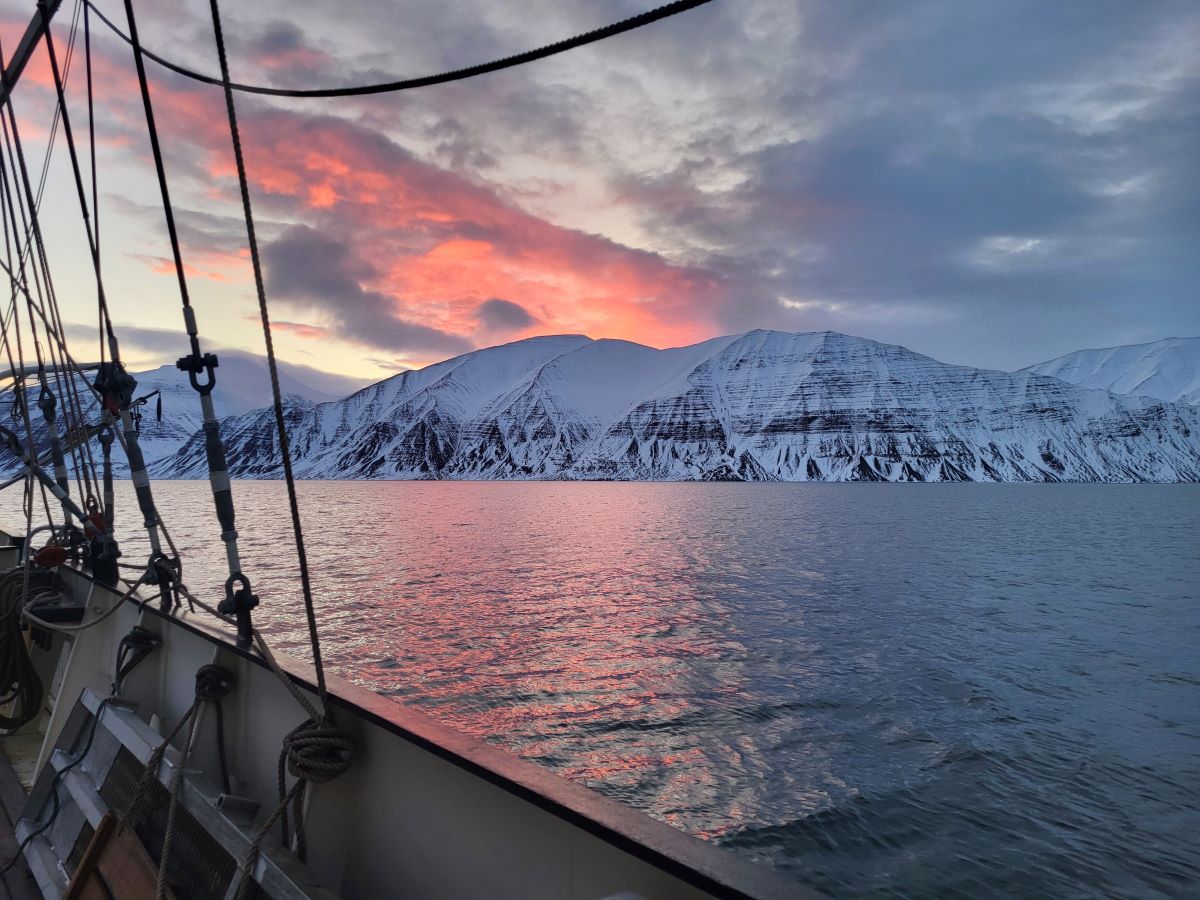
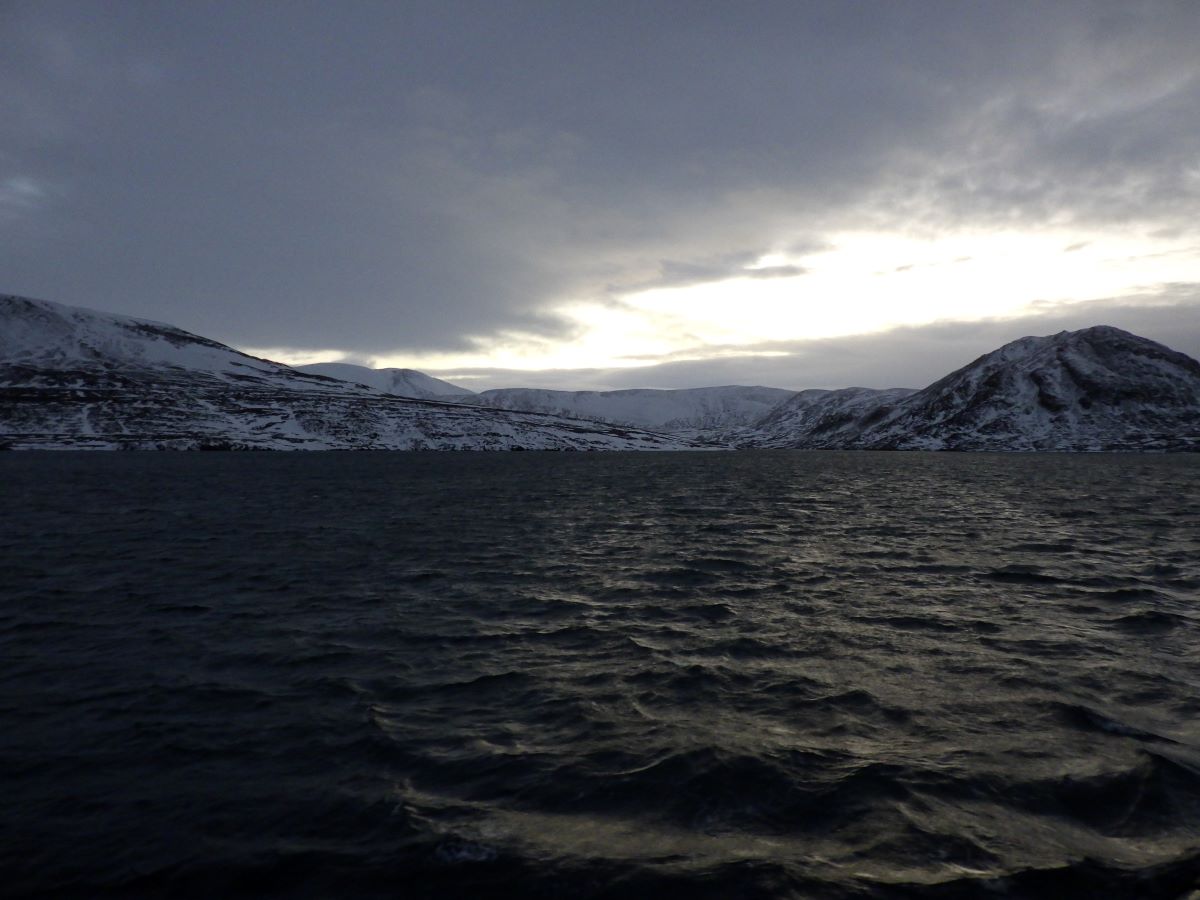

After that very blowy day the wind eased some over night, and the following morning we set off. Because the wind had blown us completely around we had to untangle the anchor chains, which required some clever use of the anchor winch. And we were off, wending our way down the fjord (Murchinsonfjorden) and out to the open ocean. The sky cleared some, and the sun was visible, and we raised some sails, and then opened up all four big square sails since we were going dead downwind, and we really sailed – turned off the engine and everything. It was GLORIOUS. The wind was still blowing hard, but only to produce a lot of whitecaps, not to peel the foam off the tops and hurl it about. Plus, we were going downwind, so there was less wind on us. The worst waves were from the stern, and they weren’t bad, so we just hammered along, sometimes exceeding nine knots. I don’t know if everyone was as thrilled as I was, but everyone looked really happy to be moving, to be doing things with the ship instead of thinking about work, to have the engine off and be going like that. As I might have said before, there were not many sailors in our group of artists. When we were talking about our applications and if we’d applied before, I allowed as how I’d applied several times, but was likely not accepted because my essays were basically “yes I make nice art, lemme on the BOAT!” which is not generally conducive to acceptance.
We sailed away from Nordaustlandet, and across the deep channel between it and Spitzbergen, and then across what looked like a channel but is instead a deep fjord that goes almost all the way into Spitzbergen to Longyearbyen, but there is 30km of land we’d have to drag the ship over (joke), so we went around and further along to Woodfjorden (I am spelling like this because I loved hearing Sarah say it). Woodfjorden is deep and narrow – we went a ways south in it, and anchored off a low spit of land (another delta from a melting glacier) and sent several parties ashore. Some were landed farther away from the spit and hiked in, others were landed on the spit for projects. I went with the second mate just to keep him company in the zodiac. We dropped off two sets of shore people, and then looked at the way the water changed color near the spit and traced out where that happened. I think it was mostly melt-water taking the finest of the sediment away, but it was rusty red instead of the usual milky blue green.
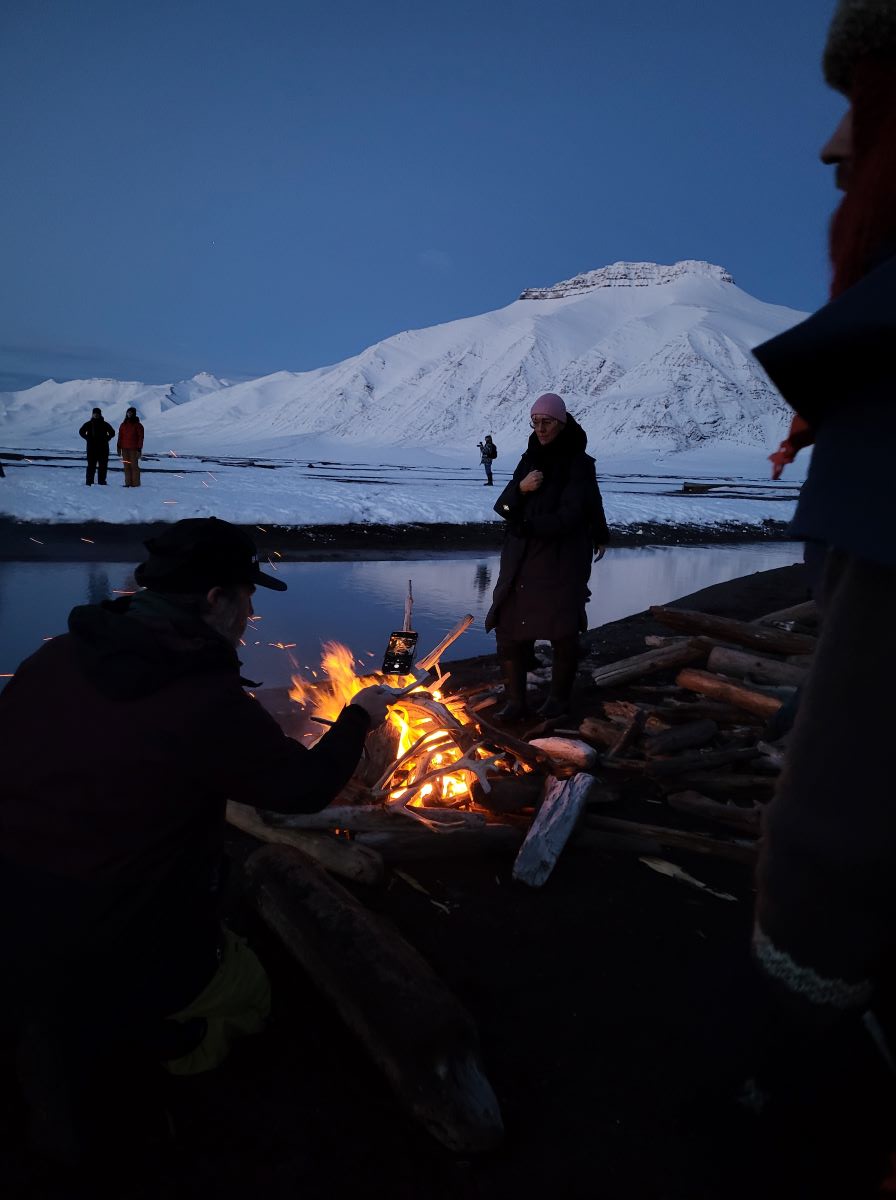
Later that afternoon we all went ashore and gathered driftwood. Svalbard has a law across the archipelago that any man made thing older than 1946 is a historical remnant, and has to be left alone, so we could gather all the wild driftwood we could see, but anything that looked worked, or had square ends had to be left alone. It still left us with plenty of things to burn, and (it turns out) even the wettest things will burn with enough gasoline poured on them. We got to stay ashore with the fire as the night darkened around us, and slowly the planets, and then some stars became visible. The combination of the dusk settling and the sparks rising was magical. What I though twas Venus turned out to be Jupiter, over one of Orion’s shoulders, with Mars over the other. The dipper, and Cassiopeia were easy to find, and the Pleiades. We had to go back to the ship, being out in the dark was hard on the guides. One of the women wanted to try to take pictures of the stars, so we left her camera pointed away from the waning fire and the guides picked it up after we had supper aboard.
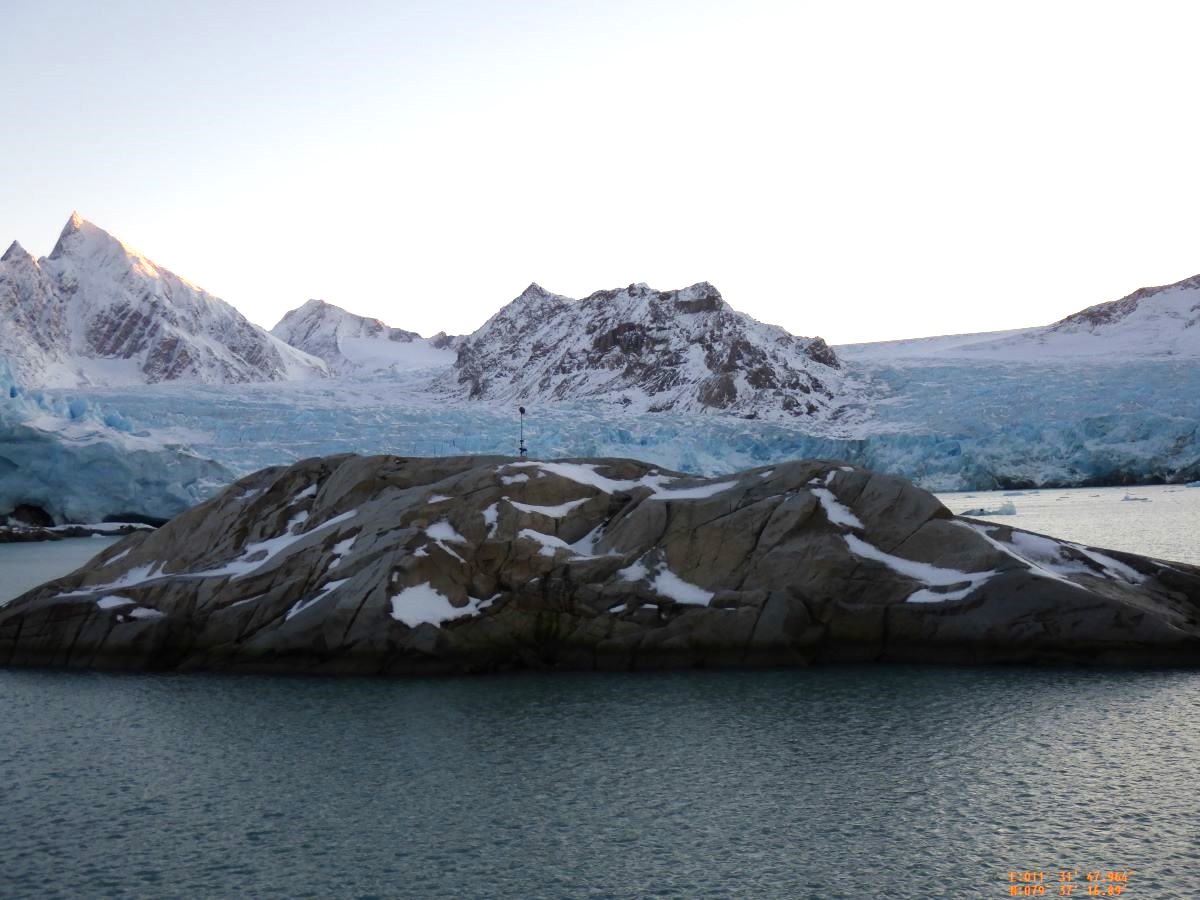
We left Woodfjorden later that evening, staring at the remains of the fire, and the stars overhead. As well as stars, there were aurora flickering around the southern horizon, starting small but then swelling up the vault of the sky. I went to bed early but woke up when we turned out of the fjord and headed west again. There were big swells leftover after the big wind, and they were catching us on our quarter and making the ship roll a lot. After getting up five or six times to secure things that were banging, I gave up on sleep and went up to the wheelhouse to keep the third mate company. We slowed down substantially, so that we’d round a corner into a new fjord just as the light came up. It was stunning – the ragged peaks of the big western island really were spiky, the origin of the name Spitzbergen, and were caught in the dawn light. We worked our way further in and anchored, and I tapped out of the morning having essentially stood a watch.
The space at the end of the fjord was filled with floating ice from the glacier, and amongst the ice were small rocky islands, reminding me irresistibly of Maine. After lunch, I was with a group that landed on one island to make videos of two artists doing things on the other island. One was dancing, which was lovely; wild and mysterious. The other was cleaning the island. She had swept all the snow off a previous island, one about the size of a small room and flat as a tabletop. The snow was fresh, and she pushed a broom back and forth, clearing the snow off like it was cleaning a room. This island was harder to clean, in part because it was not flat but very humped up, and also the snow had frozen on it in patches. She got a bucket of sea water and went after some of it with a scrub brush. Sitting on the other island watching and recording these antics was fun, watching other artists accomplish their things.
After that, I stayed in the zodiac with another performance artist who wanted to record some things in front of some of the floating ice. Just after we finished, the glacier calved While We Were Watching – a great chunk of it just plummeted into the ocean, in front of our eyes, with a plume of ice dust and a big wave radiating out from it. The zodiac surfed the wave easily, but a room sized piece of ice floating near by rolled over while we were watching, and then broke up into two big pieces and endless bergy bits. We were so stunned watching all this happen we were speechless, just sitting and looking at the ice and back at each other with our mouths hanging open in astonishment.
Eventually things stopped happening – the ice floating near us seemed stable, so we could get around it to get to the ship, and no further bits fell off the glacier, so we headed back, still stunned, asking each other “did you SEE that???”
 Lee Thomson