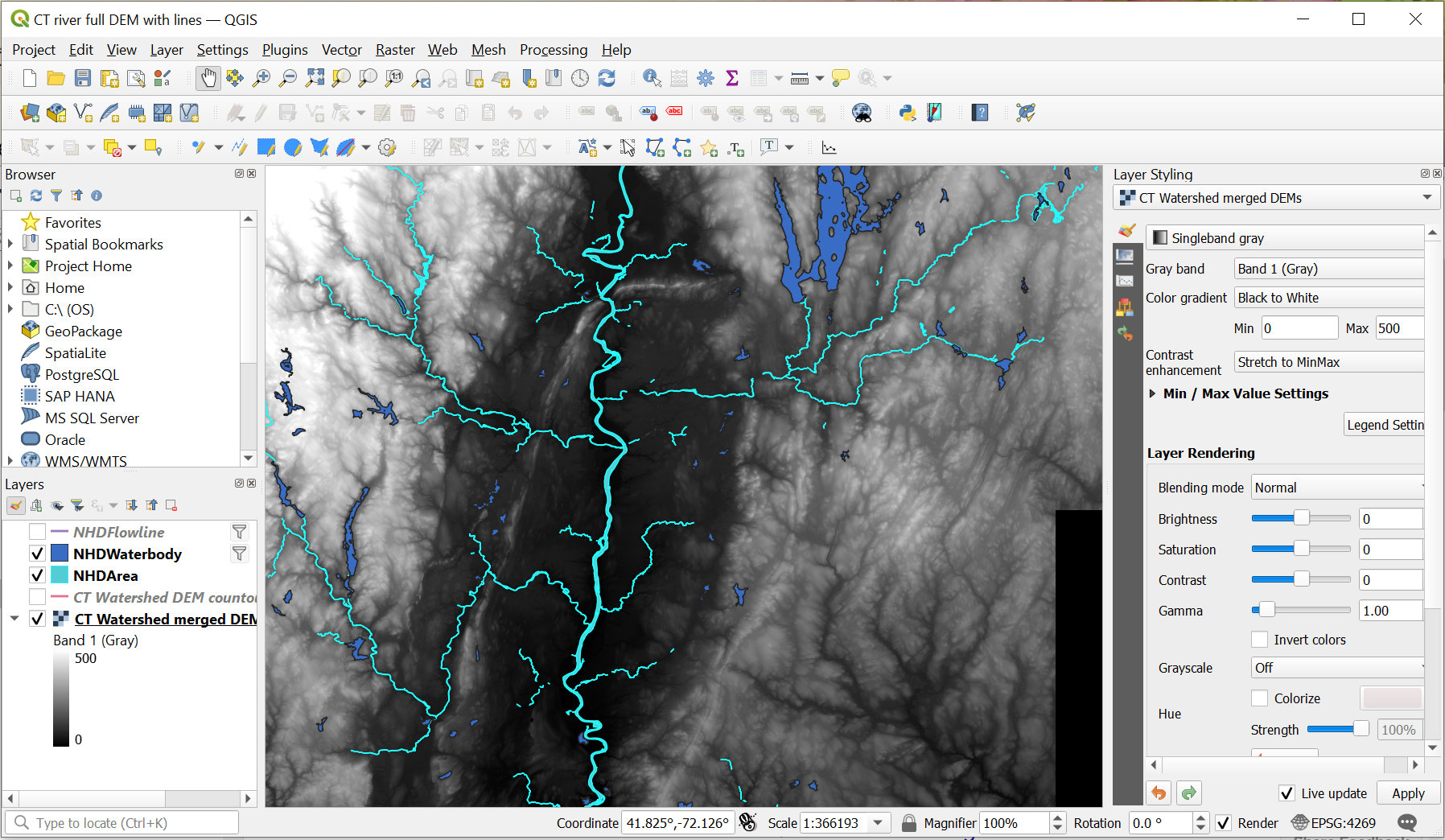
When I start choosing new sections of river to build into boxes, I have to start with digital data. I have a digital elevation model (DEM) and sections of the national database that includes rivers, water bodies and flow lines for streams. When I get it all into a geographic information system, it looks like this:
I use an open source GIS called QGIS, and it lets me see the layers I have, manipulate them, and extract the area I am interested in. Here you can see elevation (brighter is higher elevation) and the rivers and waterbodies along the Connecticut River. The big blue lake is Quabbin Reservoir, where Boston drinking water comes from.
Once I have the pieces of landscape I am interested in on the screen, I export a file of linework. It looks like this:
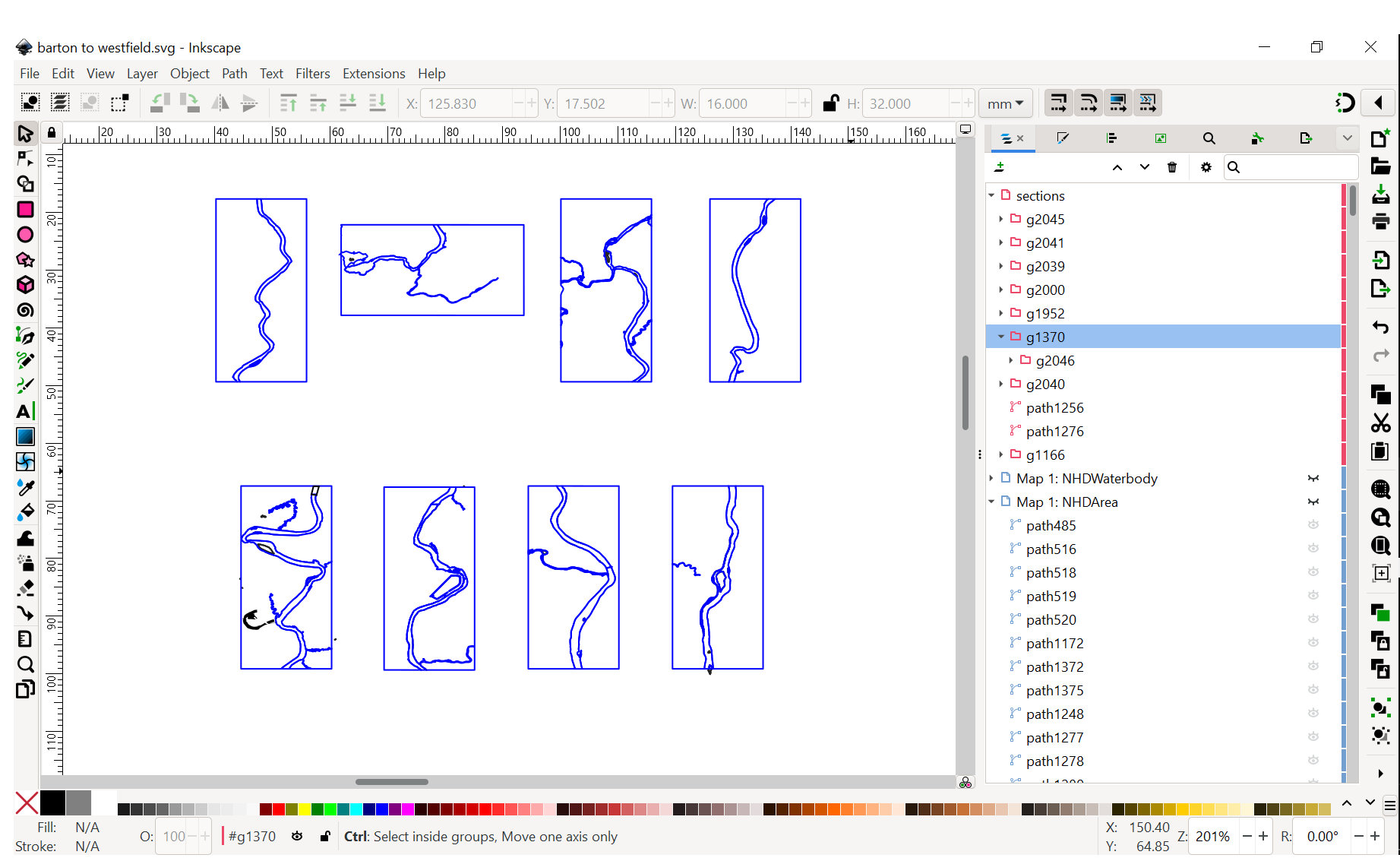
Then I make a little box, and clip out sections of the river that will be turned into little boxed landscapes. The end result looks like this:
If you look closely at the little boxes, you can figure out which sections of river they are.
This is the first half of the process. Once I have linework, the laser cutting can begin. I’ll show that next week!
Alice and I took advantage of gorgeous weather and went down to Mystic Seaport to see both the ships at the seaport and also the Wooden Boat Show that was happening at the same time.
There were a lot of really lovely boats. Big ones were along the docks in the water, for touring if you were thinking about buying them. Little ones were everywhere – on trailers or stands on the common, in the water along the docks, with people standing next to them to explain or answer questions.
One Greek history aficionado had built a kind of mini, one man trireme, with a foam rubber ram on the bow and an extremely complex way of organizing the oars. There were a lot of catboats, of various sizes. The Cocktail Class tiny powerboats had a full squadron in attendance. Mostly they were sailing boats of various sizes, but we saw one big motor-sailer and a lightly renovated fishing boat that were also delightful.
We went to a lecture about how the seaport was repairing the sheer of LA Dunton, a Gloucester fishing schooner built in 1921 and acquired by the seaport in 1972. They’d done some renovations on her in the 1980s, but her sheer – the long line that defines the top of the hull – had become horribly hogged (bent the wrong way). They had made a plan to fix it, starting with detailed drawings of what she had looked like in her youth, drawn in part from photos. Then with plans in place, they’d hauled her out the water and onto the hard (preparing a dead level, two foot wide, concrete pad for her to sit on) and started the next steps. Which were to get everything out of the hull – all the interior walls, the concrete ballast (broken up with a jack hammer and removed) and any remaining bits. The ballast had extraneous bits of metal thrown into it to make it heavier, and they had a small display of broken handles, bits of wrought iron and also a cast iron skillet. After the interior was entirely bare, they could look at the hull and see what kind of shape it was in. It was in very rough shape.
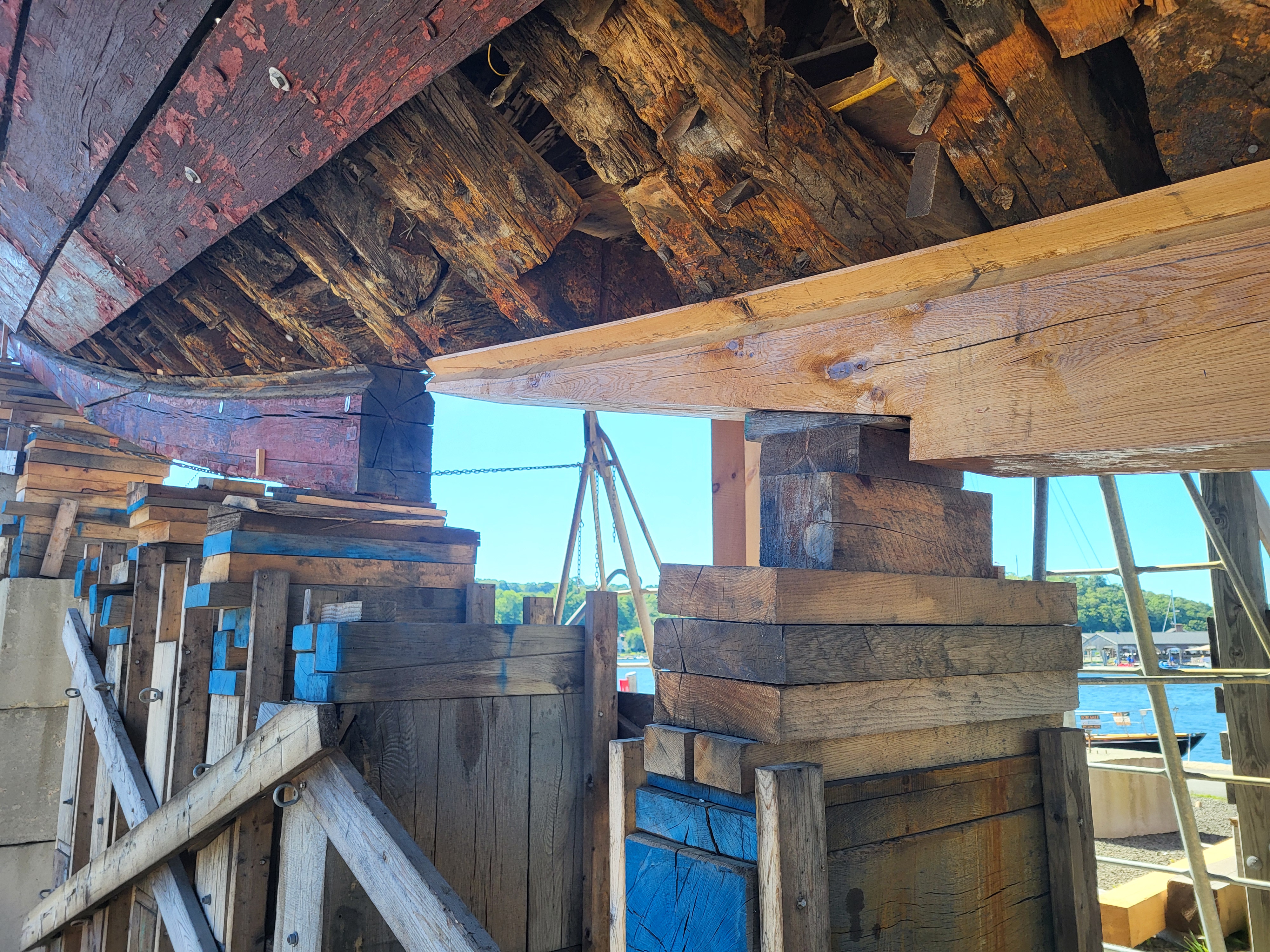
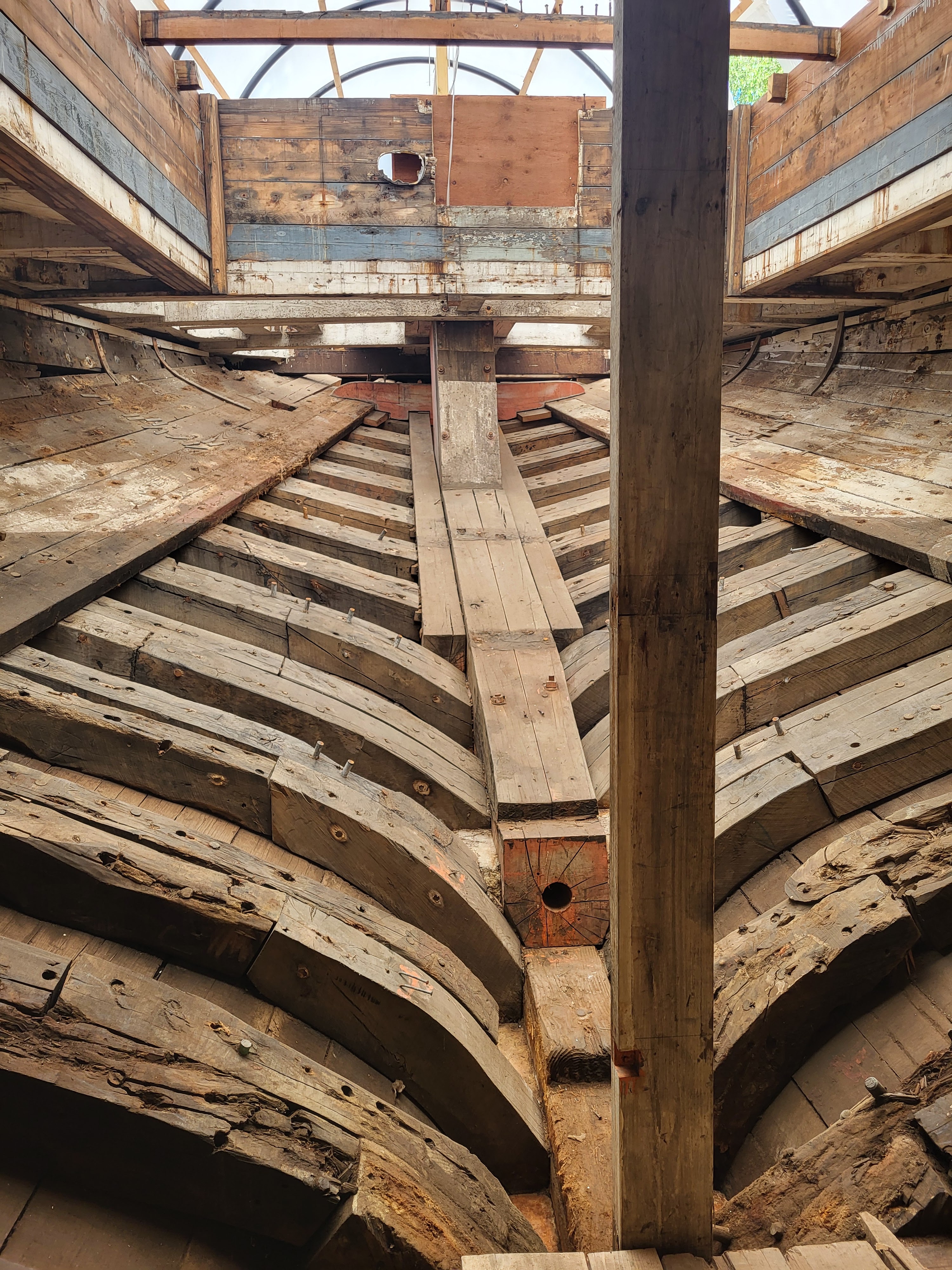
The short story is that they had to loosen up some parts of the hull, notably the keel, so that the ends of the ship could be jacked back into place. Once the jacks were set, they started lifting the bow, and inch or two every day, until after a month they had lifted it three and a half feet – nearly forty inches. And then they built a giant staircase up the outside to let visitors come look, and because they are working on ADA compliance, they also cut a hole for a little three person elevator to go up into the interior. Which is where some of the photos above came from. Look at the gaps in the planking, and notice too the number of holes and pegs holding planking onto the big ribs. Essentially they are taking the ship apart and rebuilding it exactly the way it was originally built.







 Lee Thomson